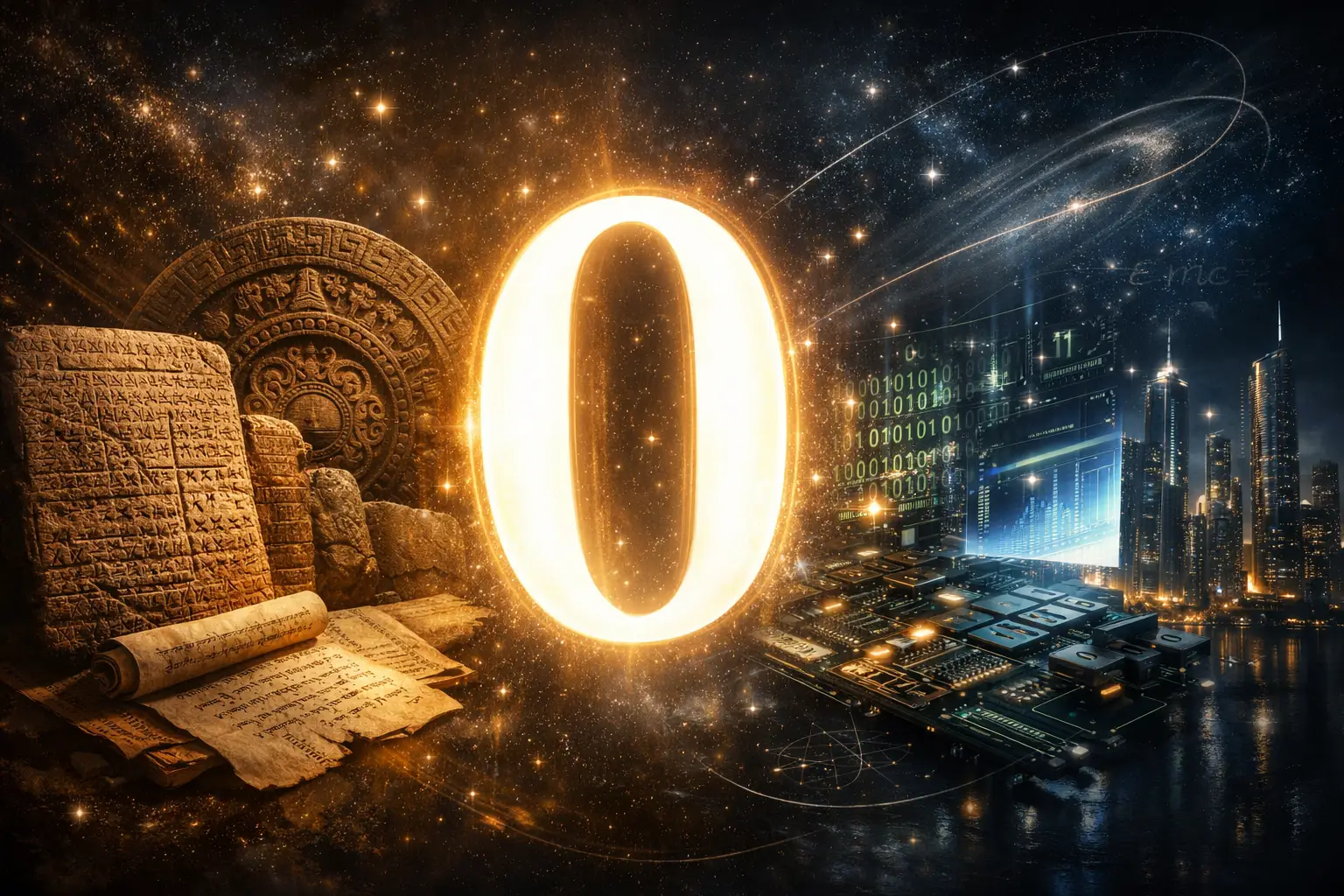
Of all the numbers humanity has ever conceived, none has proven more revolutionary, or more paradoxical, than zero. It is simultaneously nothing and everything: a placeholder that makes modern mathematics possible, a philosophical concept that terrified ancient civilizations, and a binary digit upon which the entire digital age rests. Zero is the void from which our understanding of the universe springs, and without it, science, engineering, finance, and technology as we know them simply could not exist.
The story of zero is the story of human intellectual progress itself. Its journey from an empty space on a Babylonian clay tablet to the foundation of quantum computing spans thousands of years, crosses multiple civilizations, and touches nearly every domain of human knowledge. Understanding the importance of zero is understanding why civilization works.
A Late Arrival: The Historical Origins of Zero
What makes zero remarkable among numbers is how late it arrived. Humans counted with natural numbers for tens of thousands of years before anyone thought to formalize the concept of "nothing" as a number. The earliest known tally marks date back roughly 40,000 years, carved into bones and cave walls. Yet it took until roughly the mid-first millennium CE for zero to be fully recognized as a number in its own right.
Babylon: The Empty Column
The Babylonians, working around 300 BCE, were among the first to grapple with the problem that zero solves. Their number system was sexagesimal, base 60, and positional, meaning the value of a digit depended on where it appeared. But without a symbol for an empty position, the number 3,602 and the number 62 could look dangerously similar. To solve this, Babylonian scribes began using a pair of small wedge marks as a placeholder. This was not yet zero as a number; it was zero as punctuation, a way of saying, "nothing goes here." The Babylonians never used it at the end of a number or treated it as a value that could be manipulated. But the seed had been planted.
The Maya: An Independent Discovery
Half a world away and several centuries later, the Maya civilization independently developed a true zero, represented by a shell-like glyph. The Mayan Long Count calendar, which tracked vast stretches of time, required a positional number system, and their zero served as both a placeholder and a calendar marker. Mayan mathematicians were using zero as early as the 4th century CE, making their system one of the most sophisticated in the ancient world. Tragically, the destruction of Mayan texts during the Spanish colonization meant that this discovery had little influence on the global history of mathematics.
India: The Birthplace of Modern Zero
The zero we use today traces its lineage most directly to India. The concept of śūnya, meaning "void" or "emptiness", was deeply embedded in Hindu and Buddhist philosophy long before it became a mathematical tool. The Indian mathematician and astronomer Brahmagupta, writing in 628 CE in his work Brāhmasphuṭasiddhānta, was the first known scholar to define arithmetic rules for zero. He described zero as the result of subtracting a number from itself, and he laid out rules for adding, subtracting, and multiplying with zero. He also attempted to define division by zero, arriving at conclusions that later mathematicians would refine.
Before Brahmagupta, the Indian astronomer Aryabhata (476–550 CE) used a place-value system that implicitly relied on zero, and the Bakhshali manuscript, a mathematical text discovered in 1881 in what is now Pakistan, contains a dot symbol used as zero, with carbon dating placing portions of it as early as the 3rd or 4th century CE, though its exact age remains debated.
The crucial Indian innovation was conceptual: they treated zero not merely as a placeholder but as a number, an entity with its own properties and rules. This leap of abstraction transformed zero from a notational convenience into a full participant in arithmetic.
The Islamic Golden Age and the Journey Westward
The great Persian mathematician Muḥammad ibn Mūsā al-Khwārizmī, working in Baghdad in the early 9th century, was instrumental in transmitting Indian numerals, including zero, to the Islamic world. His treatise on arithmetic, which described the Hindu numeral system, was later translated into Latin, and al-Khwārizmī's name itself became the root of the English word "algorithm." The Arabic word for zero, ṣifr (meaning "empty"), traveled into Latin as zephirum, which eventually became "zero" in Italian and English and "cipher" in other contexts.
When the Italian mathematician Fibonacci published Liber Abaci in 1202, he introduced Europe to the Hindu-Arabic numeral system he had learned while studying with Arab mathematicians in North Africa. Despite significant resistance from European merchants and scholars who were deeply attached to Roman numerals, the new system, complete with zero, gradually prevailed because it was simply far more efficient for calculation. Roman numerals have no place-value system and no zero; try multiplying MCMXLIV by CDLXXVIII on paper, and the advantage becomes viscerally clear.
Why Zero Matters: Mathematics
The Foundation of Place-Value Notation
The most immediate practical importance of zero is its role in positional number systems. In our base-10 system, the digit "5" means five, fifty, five hundred, or five million depending entirely on its position, and zero is what holds the empty positions. The number 502 means five hundreds, no tens, and two ones. Without zero, this elegant compression of information collapses. Roman numerals required new symbols for every order of magnitude (I, X, C, M), making arithmetic cumbersome and higher mathematics nearly impossible.
This positional power scales to any base. In binary (base 2), the foundation of all digital computing, zero is one of only two digits. In octal, hexadecimal, and every other base system used in computer science, zero serves the same indispensable positional role.
Algebra and the Number Line
Zero is the additive identity: any number plus zero equals itself. This seemingly trivial property is one of the foundational axioms of algebra. Zero also serves as the boundary between positive and negative numbers on the number line, giving structure to the entire system of integers. Without zero, the concept of negative numbers becomes far more difficult to formalize, and equations as basic as x + 5 = 5 have no clean solution.
In algebra, "finding the zeros" of a function, determining where it crosses the x-axis, is one of the most fundamental operations. The zeros of polynomials, the roots of equations, the null spaces of matrices: the concept of zero pervades every corner of mathematics.
Calculus and the Concept of Limits
Zero plays a starring role in calculus, the branch of mathematics that underpins physics, engineering, and economics. The entire framework of differential calculus rests on the idea of a limit approaching zero. When we compute a derivative, we are asking: what happens to the ratio of change as the interval of change shrinks toward, but never quite reaches, zero?
Isaac Newton and Gottfried Wilhelm Leibniz, the co-inventors of calculus in the late 17th century, both wrestled with the concept of infinitesimals, quantities that are infinitely close to zero but not zero itself. The philosophical difficulties this created took nearly two centuries to resolve, culminating in the rigorous epsilon-delta definitions formalized by Karl Weierstrass in the 19th century. Zero, in calculus, is the horizon you approach but never touch, and the mathematics of that approach unlocked humanity's ability to model motion, growth, and change.
Division by Zero: The Forbidden Operation
Zero's power is matched by its danger. Division by zero is undefined in standard arithmetic, and for good reason. If you attempt to define a ÷ 0 as some number k, then k × 0 should equal a, but anything multiplied by zero is zero, creating an irreconcilable contradiction. In a computer program, dividing by zero typically triggers a runtime error or exception; in a physical system, situations that model division by zero, like a gravitational singularity, indicate the breakdown of the theory itself. Black holes, where matter is theoretically compressed to zero volume and infinite density, represent perhaps the most dramatic real-world encounter with the paradoxes of zero.
Zero in Science and Physics
Absolute Zero
In thermodynamics, absolute zero (0 Kelvin, or −273.15°C) represents the theoretical lowest possible temperature, the point at which particles possess minimal thermal motion. The Third Law of Thermodynamics states that a system's entropy approaches a minimum as it approaches absolute zero, and reaching absolute zero exactly is physically impossible, a kind of asymptotic limit reminiscent of zero's role in calculus. Scientists have cooled matter to within billionths of a degree of absolute zero, producing exotic states of matter like Bose-Einstein condensates, but the limit itself remains unattainable.
Zero-Point Energy
Quantum mechanics reveals that even at absolute zero, particles are not perfectly still. The Heisenberg uncertainty principle forbids it: you cannot simultaneously know a particle's exact position and momentum, so there must always be some residual energy. This zero-point energy is the lowest energy state a quantum system can occupy, and it has measurable physical consequences, including the Casimir effect, where two uncharged metallic plates placed extremely close together in a vacuum experience a small attractive force due to quantum fluctuations in zero-point energy.
The Role of Zero in Einstein's Equations
Einstein's field equations in general relativity describe the relationship between the geometry of spacetime and the distribution of matter and energy. Setting certain terms to zero produces special solutions: a zero cosmological constant gives a static (non-expanding) universe, while zero curvature describes flat Minkowski spacetime. The interplay of zero and non-zero terms in these equations has shaped our understanding of the Big Bang, cosmic expansion, and the possible fate of the universe.
Zero in Computing and Technology
Binary: The Language of Machines
Modern digital computing is built on binary, a base-2 number system using only the digits 0 and 1. Every photograph, email, video, financial transaction, and line of code ever processed by a computer is ultimately represented as a sequence of zeros and ones. Zero, in this context, is not absence, it is one of the two active states that encode all information.
Claude Shannon's 1937 master's thesis demonstrated that Boolean algebra, which operates on true (1) and false (0), could be implemented with electrical circuits. This insight is the theoretical bedrock of all digital electronics. Every transistor in a modern processor is essentially a switch that is either on (1) or off (0), and a modern CPU contains billions of these switches, performing billions of zero-or-one decisions every second.
Null, Zero, and False: Distinct Concepts
In programming, zero carries nuanced meaning. The integer 0, the null pointer, the Boolean false, and an empty string are all conceptually related to "nothing" but are distinct types with different behaviors. In C, for instance, zero serves triple duty: it is the integer 0, it is the null pointer constant, and it is the Boolean false value. In JavaScript, zero is "falsy," meaning it evaluates to false in a Boolean context, while in SQL, NULL is distinct from zero and represents the absence of any value at all and NULL is not even equal to itself.
These distinctions matter enormously in practice. A database field containing zero means a measurement was taken and the value was zero; a NULL field means no measurement was taken at all. Confusing the two has caused countless bugs and billion-dollar errors.
The Y2K Bug: A Lesson in Zeros
The Year 2000 problem, Y2K, was fundamentally a problem about zeros. To save memory in an era when storage was expensive, programmers had represented years using only two digits: "98" for 1998 and "99" for 1999. When the calendar rolled over to 2000, these systems would interpret "00" as 1900, potentially causing failures in banking, aviation, power grids, and defense systems. The worldwide effort to remediate Y2K is estimated to have cost over $300 billion, all because of the ambiguity of two zeros.
Zero in Philosophy and Culture
The Fear of the Void
Zero's journey was not merely a technical challenge; it was a philosophical and even theological battle. The ancient Greeks, despite their extraordinary mathematical achievements, largely rejected the concept of zero. Aristotle argued against the existence of a void (the vacuum), and since zero represented "nothing," it seemed to contradict the Greek worldview that nature abhors a vacuum. The Pythagoreans, who believed that numbers were the divine language of the universe, had no room for a number that represented non-existence.
In medieval Europe, the Church was initially suspicious of zero. The void smelled of heresy; it suggested a world where something could come from nothing, or where God's creation contained absences. The Hindu-Arabic numerals, including zero, were banned in Florence in 1299, partly due to fear that the easy-to-forge "0" would enable fraud but partly because the entire system was seen as foreign and dangerous.
Eastern Embrace
In contrast, Indian and East Asian philosophical traditions were far more comfortable with the void. The Buddhist concept of śūnyatā (emptiness) and the Taoist principle of wu (non-being) treated nothingness not as a deficiency but as a generative principle, the fertile void from which all things emerge. It is no coincidence that zero was born and nurtured in cultures that saw emptiness as fundamental rather than frightening.
Zero in Economics and Finance
Zero is a critical threshold in finance and economics. An interest rate of zero, the "zero lower bound", represents the floor below which central banks traditionally cannot push monetary policy (though negative interest rates have been experimented with in Japan and Europe). Zero inflation is a target that most economies aim near but not exactly at. A company's stock reaching zero means total loss. A zero-coupon bond pays no periodic interest, instead selling at a discount and maturing at face value, its entire return embedded in the distance from zero to par.
The concept of a "zero-sum game" in economics and game theory describes a situation where one participant's gain exactly equals another's loss, with the total change summing to zero. While many real-world economic interactions are positive-sum, the zero-sum framework remains a powerful analytical tool, especially in competitive contexts like trading and negotiation.
Zero's Continuing Frontier
Zero remains at the cutting edge of science and mathematics. In quantum computing, the qubit exists in a superposition of 0 and 1 simultaneously, exploiting the quantum nature of zero and one to perform computations that classical binary computers cannot. In string theory and cosmology, questions about whether the universe emerged from a state of absolute nothing, true zero, continue to drive research. The Riemann Hypothesis, one of the greatest unsolved problems in mathematics (with a $1 million prize from the Clay Mathematics Institute), concerns the distribution of the zeros of the Riemann zeta function, and its resolution could reshape our understanding of prime numbers.
Zero is the most understated revolution in human thought. It is a number that means nothing and enables everything. From the clay tablets of Babylon to the silicon chips of modern processors, from the philosophy of the void to the physics of black holes, zero has been a constant companion to human progress, invisible, indispensable, and endlessly profound.
The next time you see a zero on your screen, in a price tag, or on a thermometer, consider the millennia of intellectual struggle it took to put it there. That small, round symbol is not an absence. It is, perhaps, the most powerful idea humanity has ever had.