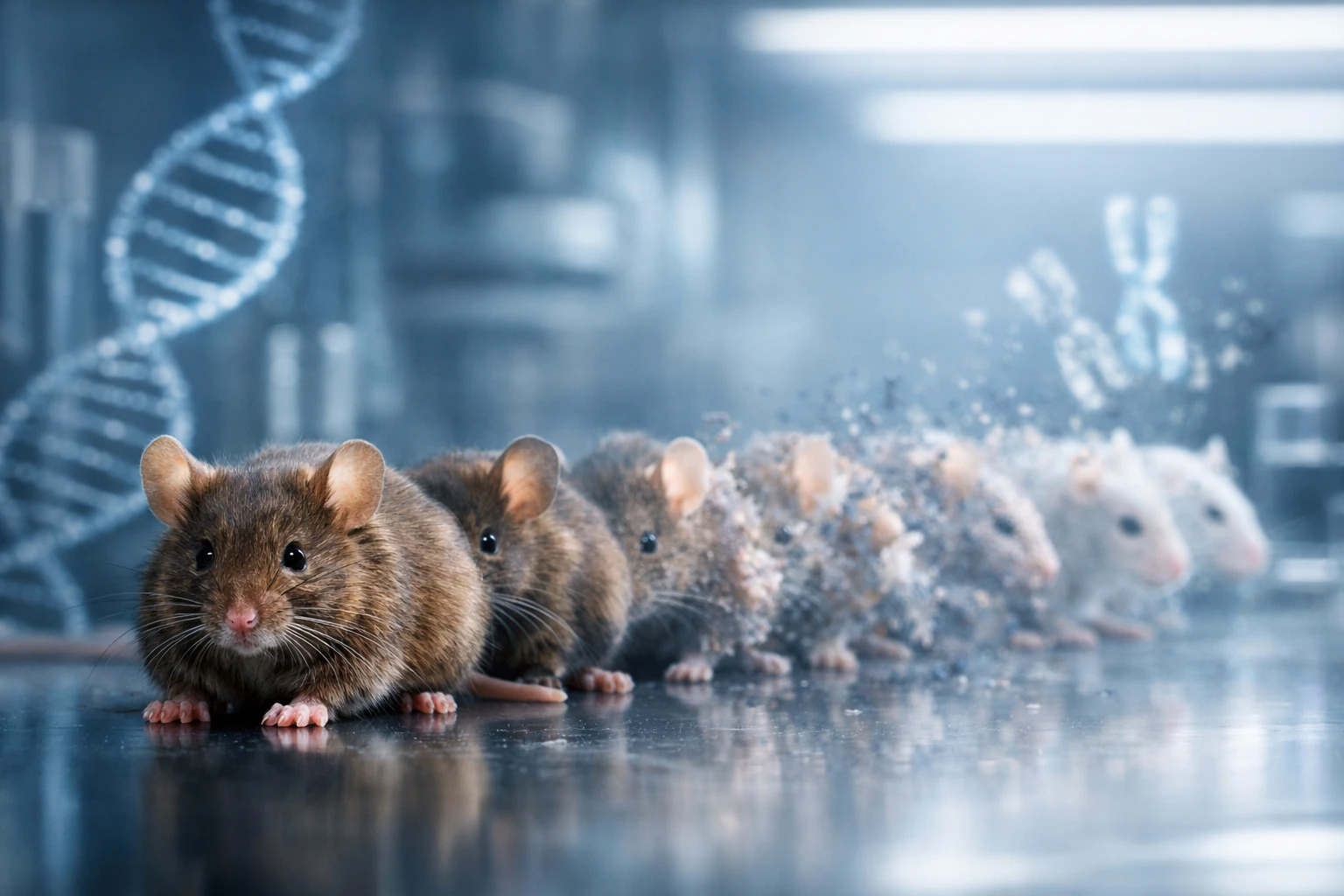
For three decades, the science of cloning has fired the imagination of biologists, conservationists, and futurists alike. Clone an endangered snow leopard to pull it back from the brink. Clone elite livestock to mass-produce superior herds. Clone a beloved pet so its owner never has to say goodbye. At its most ambitious, the dream was near-infinite: given good enough technique, a single animal's DNA could theoretically be copied forever, an immortal genetic blueprint endlessly reproduced.
A landmark study published on 24 March 2026 in the journal Nature Communications has put a hard full stop on that vision. After 20 years, 58 generations, and more than 30,000 cloning attempts, all started from a single female mouse, a team at Japan's University of Yamanashi has shown, for the first time, that serial mammal cloning has a biological ceiling. Push past it, and the copies disintegrate. The finding is the first empirical proof in mammals that asexual reproduction carries an inescapable genetic penalty, one that grows with every generation until it becomes fatal.
A Brief History of Copying Life
The story begins, as so many stories in modern biology do, with a sheep. Dolly, born in July 1996 at the Roslin Institute in Edinburgh and announced to the world in February 1997, was the first mammal cloned from an adult body cell. Her creation, led by embryologist Ian Wilmut, required 277 attempts before one embryo survived to term. Dolly looked perfectly ordinary, a white-faced Finn Dorset sheep, but she was a scientific revolution dressed in wool. She proved that the DNA in a fully differentiated adult cell could be rewound to an embryonic state and used to build an entirely new animal.
The technique Wilmut's team used is called somatic cell nuclear transfer, or SCNT. A somatic cell is any ordinary body cell, a skin cell, a cumulus cell from the ovary, or a fibroblast, as opposed to a sperm or egg. In SCNT, the nucleus is extracted from one of these donor cells and transplanted into an egg cell from which the nucleus has been removed. The egg's cytoplasm, rich in proteins, enzymes, and molecular signals, then goes to work reprogramming the donated DNA, erasing the memory of being a skin cell and restoring it to a totipotent state capable of developing into a whole organism. The reconstructed embryo is then implanted into a surrogate mother.
Just one year after Dolly, in 1997, a young Japanese reproductive biologist named Teruhiko Wakayama and his colleagues at the University of Hawaii achieved another landmark: the first cloned mouse, named Cumulina. Wakayama used cumulus cells, the cells that surround a developing egg, as his donor source and produced multiple generations of healthy mice. The achievement confirmed that SCNT was not a one-species trick. In the years that followed, the list of successfully cloned mammal species grew to include cattle, goats, pigs, rabbits, cats, dogs, horses, and eventually primates, including the cynomolgus monkey.
The Twenty-Year Experiment
In 2005, Wakayama, by then a professor at the University of Yamanashi, working alongside his wife and fellow reproductive biologist Sayaka Wakayama, launched an experiment of unusual ambition and patience. Starting from a single donor female mouse, they created a clone. When that clone reached three months of age, they cloned it again. That second-generation clone was itself cloned at three months, producing a third generation. And so on. Three to four new generations were produced each year.
The experiment was, as one commentator described it, "heroic" in its scope. Over 20 years, the team conducted more than 30,000 individual cloning attempts, producing a total of 1,206 mice. All of them were female, all brown-furred, genetic sisters to one another and genetic daughters of the original donor.
Crucially, the team was not simply counting heads. They were tracking health, lifespan, fertility, placental size, and, eventually, the DNA sequence of the clones themselves. The genomes of ten clones drawn from across the generations were sequenced and compared to normally reproduced mice, providing a molecular record of what was happening inside the cells as the generations ticked by.
The Ticking Clock: What Happened Generation by Generation
For the first two decades of the experiment, up to roughly the 25th generation, things looked almost impossibly good. The clones appeared healthy. Their lifespans were normal. They were fertile. The success rate of the cloning procedure, far from declining, actually rose steadily. From an initial rate of about 7%, the proportion of reconstructed embryos that resulted in live births climbed to a peak of 15.5% by around generation 26. In a 2013 paper published in the journal Cell Stem Cell, Wakayama's team reported these early findings and ventured an optimistic conclusion: it might be possible to reclone animals indefinitely.
That conclusion, as Wakayama now acknowledges, was premature. The critical error was that the 2013 study did not sequence the genomes. The mice looked fine. Their DNA was already silently rotting.
Starting around generation 27, the picture changed. The birth rate of clones began to fall. The mice that were born developed larger than normal placentas, a known marker of incomplete epigenetic reprogramming in SCNT. Litter sizes shrank. Chromosomal abnormalities appeared, including a particularly striking one: some clones had lost an entire copy of one of their X chromosomes. In female mammals, which normally carry two X chromosomes, that is a serious genomic wound.
The decline was inexorable. By generation 57, the success rate had collapsed from its 15.5% peak to a mere 0.6%, fewer than one in 160 embryos survived to birth. And the generation-57 mice that did survive were still, on the surface, apparently normal. They lived for roughly two years, the same lifespan as uncloned control mice.
Then came generation 58. Every single mouse died within a day of being born. There were no visible physical abnormalities. The cause of death remains unknown. After 58 cycles of copying, life had simply run out of runway.
What the Sequencing Revealed: A Flood of Silent Mutations
The genome sequencing data offered a stark explanation for the collapse. The serial clones were accumulating mutations at roughly three times the rate of mice born through natural sexual reproduction. On average, each cloned generation added approximately 70 new point mutations (individual "spelling errors" in the DNA code) and around 1.5 structural variations, deletions, insertions, inversions, or translocations of entire segments of chromosomes. In the early generations, the cell's DNA repair mechanisms could apparently compensate, keeping the damage in check. Past generation 25 or so, that capacity was overwhelmed. The errors continued piling up and could no longer be repaired. The result, in genetic terms, was a slow-motion avalanche.
Wakayama offers a useful analogy: imagine photocopying a document, then photocopying the photocopy, then copying that, generation after generation. Each copy introduces a small amount of additional noise, blurring, and distortion. For the first few dozen rounds the document remains legible. Eventually, the text is unreadable. The genome of the 58th-generation mice was, in a sense, too far from the original to sustain life.
"It was once believed that clones were identical to the original," Wakayama said, "but it has become clear through this study that mutations occur at a rate three times higher than in offspring born through natural mating." The implications are unsettling: a cloned animal is not a perfect copy. Even the first-generation clone carries a slightly different, somewhat more error-prone version of its donor's genome.
Why Does Cloning Accumulate Mutations?
To understand why serial cloning degrades the genome so rapidly, it helps to understand what the SCNT process is asking of biology and why biology isn't really built for it.
When a sperm fertilizes an egg in sexual reproduction, the resulting embryo undergoes a sweeping molecular reset. Chemical tags on the DNA, methylation patterns, and histone modifications that control which genes are switched on or off are largely erased and rewritten. This process, called epigenetic reprogramming, is one of the most complex feats in developmental biology. It strips the donated genetic material of its somatic "identity" and restores it to an embryonic one.
In SCNT, the egg is asked to perform this reprogramming on a nucleus that has spent years being a specialized adult cell. Decades of research have shown that this reprogramming is never complete. Roughly 15% of embryo-specific genes that should be activated after fertilization resist activation in SCNT embryos. Certain epigenetic marks inherited from the donor somatic cell are carried over unchanged into the new embryo. The enlarged placentas seen in virtually all cloned mammals are a direct symptom of this incomplete reset, caused by abnormal expression of imprinted genes involved in placental development.
Now, critically, the SCNT process itself introduces new mutations during the reprogramming step. The cell's DNA copying machinery can make errors. The molecular environment inside an enucleated egg, while powerful, is not perfectly suited to the task of rewriting a somatic nucleus. When the resulting clone is itself used as a donor for the next generation, those errors are passed on, and new errors are added on top. Unlike sexual reproduction, there is no mechanism to filter out the damage.
"In cloning, all genes are passed on to the next generation," Wakayama explained, "meaning that all defective genes are also passed on." In sexual reproduction, harmful mutations can be eliminated. In serial cloning, nothing is ever discarded.
Muller's Ratchet: A Seventy-Year-Old Theory Finally Proven in Mammals
The genetic collapse observed in Wakayama's mice is not just a practical problem with a particular laboratory technique. It is the direct, empirical demonstration of one of evolutionary biology's most important, and until now mostly theoretical, ideas: Muller's ratchet.
Hermann Joseph Muller (1890–1967) was an American geneticist and Nobel laureate who spent much of his career thinking about the relationship between mutation and heredity. In a 1964 paper, he described a mechanism by which asexual populations are doomed to accumulate mutations over time in a way that cannot be undone. The name comes from the mechanical ratchet: a device that turns in only one direction, clicking forward one notch at a time, never backwards. Each new harmful mutation is a click of the ratchet. In asexual reproduction, once the mutation is locked in, there is no mechanism to remove it. The genome can only get worse, never better.
The reason sexual reproduction escapes this trap lies in genetic recombination. When a sperm and an egg fuse, they do not just mix their chromosomes; they physically exchange segments of DNA in a process called "crossing over." This shuffling allows offspring to inherit new combinations of mutations from both parents. Crucially, it can produce offspring with fewer mutations than either parent, as harmful variants from one parent's chromosome get paired with intact sequences from the other. Sexual reproduction acts as a filter, screening mutations out of the gene pool across generations. Asexual reproduction has no such filter.
In theory, Muller's ratchet predicts that any exclusively asexual lineage will, over time, experience a progressive accumulation of harmful mutations, a declining reproductive fitness, and ultimately what scientists call "mutational meltdown", extinction driven not by predators or disease but by internal genetic chaos. This process had been observed experimentally in RNA viruses, bacteria, and simple eukaryotes. But in mammals, it had never been directly demonstrated. Until now.
The Wakayama study provides, as the paper states, "the first empirical demonstration" that mutational meltdown occurs in serially cloned mammals. The ratchet clicked 58 times and then stopped because there was nothing left to sustain it.
Sex to the Rescue: The Experiment Within the Experiment
One of the most striking results in the study came from a side experiment that the team embedded within the main one. Female clones from near the final generations, even 57th-generation mice carrying their massive mutation burden, were allowed to mate naturally with normal, uncloned males. What happened?
Most of the embryos from these matings degenerated, reflecting the severity of the cloned females' genetic damage. But a small number developed normally and were born healthy, showing far fewer mutations than their cloned mothers.
The reason lies in the very mechanism that protects sexual populations from Muller's ratchet: meiosis. When a female produces eggs, her cells undergo a special form of cell division in which chromosomes pair up, exchange material, and then separate. This process, meiosis, is not just a means of halving the chromosome number to create a gamete. It is also an intensive quality-control step, one that can weed out certain categories of damage and shuffle genetic material into new combinations. Even sperm from a normal male, carrying healthy, unmutagenized DNA, could pair with the damaged chromosomes from a generation-57 female and produce embryos capable of development.
"Sexual reproduction is essential for the long-term survival of mammals," the study's authors conclude. This observation mirrors a broader truth in evolutionary biology: sex is expensive (requiring specialized anatomy, hormones, behavior, and another willing organism), but it pays for itself by keeping the genome clean. The Wakayama experiment provides a vivid demonstration of what happens when that cleaning mechanism is removed.
Broader Implications: Conservation, Agriculture, and the Cloning Industry
The study has direct practical consequences for several active fields that have placed heavy bets on serial cloning.
Endangered species conservation. Projects to save critically endangered animals through cloning, such as the northern white rhinoceros, the black-footed ferret, and various big cat species, have gained momentum in recent years, aided by advances in SCNT and the establishment of genome banks that preserve cells from rare animals. The new findings do not invalidate these efforts for first-generation or single-generation cloning, but they caution strongly against any plan that relies on serial recloning to expand or perpetuate a population. A cloned snow leopard from a preserved cell is genetically sound; a clone of that clone, of that clone, across many generations, is not.
Wakayama also noted a darker implication: proposals to store genetic material in a vault and reclone populations after a mass-extinction event may be far less viable than their proponents hope. A population sustained entirely by serial cloning would face genetic collapse long before it could re-establish itself.
Livestock agriculture. Cattle are cloned to produce superior milk yields; elite racehorses are copied to preserve prized genetic traits; champion bulls have been replicated for breeding programs. The industry is substantial, and it depends implicitly on the assumption that cloning is stable over multiple generations. This study suggests that the assumption needs examination. Even if commercial livestock programs do not clone clones across 58 generations, the fact that mutations accumulate at triple the normal rate from the very first cloning event means that multi-generational cloned herds carry an increasing genetic debt.
Pet cloning. A cottage industry has grown up around cloning deceased or dying pets. Companies in South Korea and the United States charge tens of thousands of dollars to reproduce a beloved dog or cat from preserved cells. These are first-generation clones of originals, not serial copies, and the new findings do not directly compromise their viability. But the study does reinforce the point that a cloned pet is not a perfect copy, it will carry more mutations than its genetic original, and it will, genetically speaking, be somewhat different from the animal its owner remembers.
Science fiction reassessed. Wakayama himself, with some wry humor, noted that the findings would have made Star Wars impossible: the Republic's clone troopers, if produced serially from a single donor like the bounty hunter Jango Fett, would have been genetically compromised long before the Clone Wars concluded.
The Road Ahead: Can the Ratchet Be Stopped?
Wakayama is frank about the limits of current knowledge. His team, he says, has "no idea" how to overcome the mutational accumulation problem using existing technology. The solution, he suggests, would require a fundamentally improved nuclear transfer technique, one that either reduces the error rate during reprogramming or introduces some mechanism to identify and discard harmful mutations before they are passed to the next generation.
Several research groups are already working on incremental improvements to SCNT efficiency. Recent work has shown that combining the overexpression of certain histone demethylase enzymes (such as Kdm4d and Kdm5b) with chemical inhibitors of DNA deacetylation can dramatically improve the reprogramming of the donor nucleus, pushing full-term development rates to as high as 30% in mice, far above the historical baseline of 1 to 5%. Whether such techniques reduce the mutation burden, rather than merely improving the chance that a compromised embryo survives, remains to be seen.
Another avenue, ironically, is to borrow from the very mechanism that serial cloning lacks: recombination. If gene-editing tools like CRISPR-Cas9 could be used to scan and repair de novo mutations in a donor nucleus before transfer, the ratchet might be slowed. This would be technically formidable, requiring whole-genome sequencing and targeted correction of dozens to hundreds of mutations per generation. But it is not theoretically impossible.
For now, the honest scientific position is one of acknowledged limitations. This was a 20-year experiment, conducted with extraordinary patience and skill, that resolved a genuine question about the biology of reproduction. The answer it delivered is humbling: mammals cannot escape their evolutionary history. They are built for sex, or more precisely, they are built against the consequences of doing without it.
What Sex Is Really For
The Wakayama study will stand as a landmark not only in the applied field of cloning research but also in the broader project of evolutionary biology. For decades, Muller's ratchet was a compelling theoretical framework but was difficult to test directly in complex animals. The 20-year mouse experiment provides the cleanest empirical evidence yet that the ratchet is real, that it clicks in mammals, and that it eventually clicks fast enough to kill.
The deeper message, paradoxically, is not about the failure of cloning. It is about why sexual reproduction, costly, complicated, and contingent on finding a willing partner, dominates the animal kingdom. Sex exists, in large part, because it is the only mechanism that runs the ratchet backwards: that takes a genome fraying at the edges and restores it, generation after generation, to something close to its original integrity. Asexual reproduction, for all its apparent efficiency, is a loan that eventually comes due.
For now, the 58th generation of mice has drawn a line. The photocopier has jammed. And the lesson, encoded in 1,206 brown-furred lives, is that the machinery of heredity was never designed to run without the mixing, shuffling, and renewal that only sex can provide.