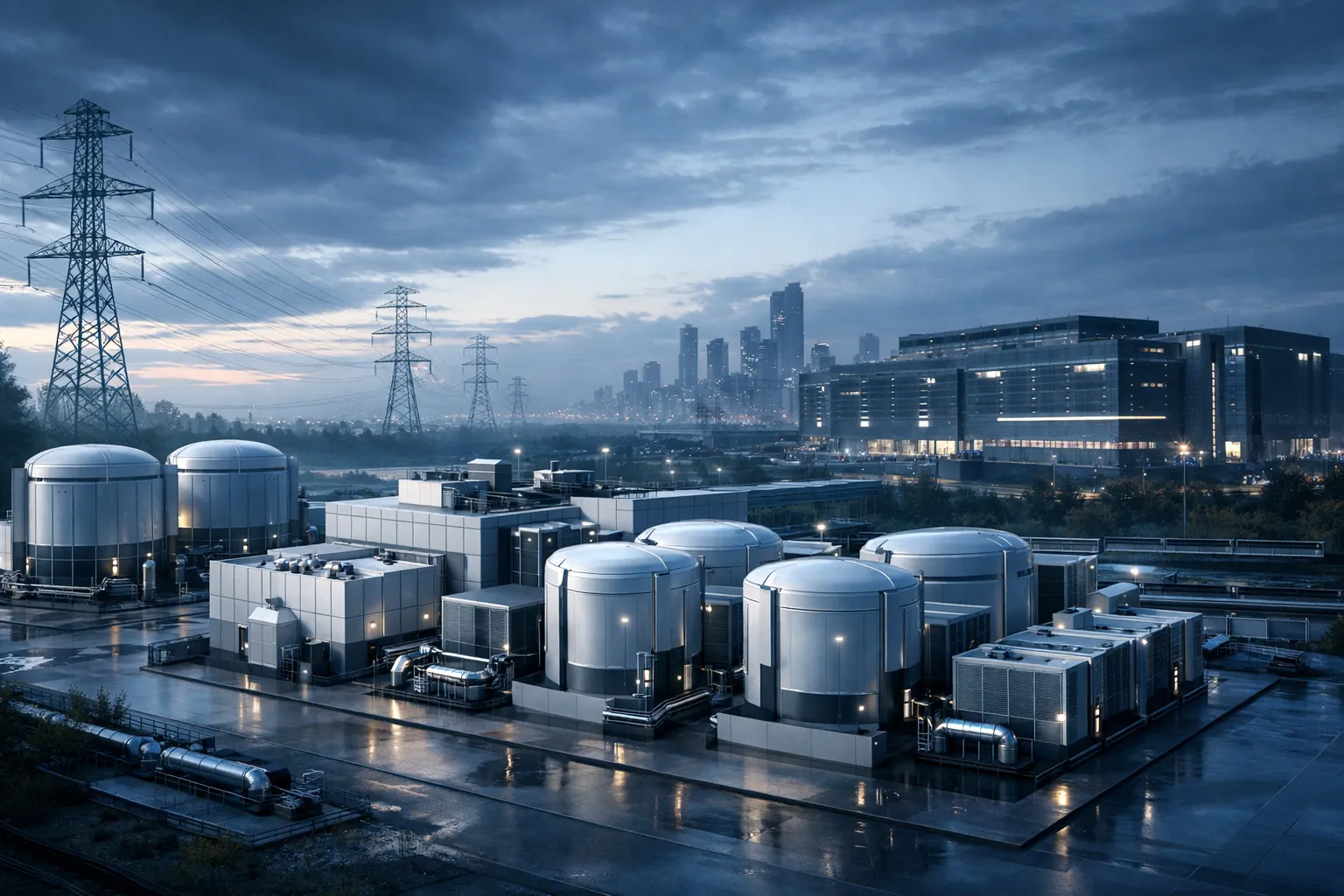
A small modular reactor, or SMR, is exactly what it sounds like: a nuclear reactor that is smaller and simpler than the massive power plants most people picture when they think of nuclear energy. Traditional nuclear reactors are enormous machines, typically producing around 1,000 megawatts of electricity (MWe) or more per unit, enough to power a large city. SMRs, by contrast, are defined as reactors that produce roughly 300 MWe or less. Some designs go as small as a few megawatts, small enough to fit on the back of a truck.
But the "small" part is only half the story. The "modular" part is where the real promise lies. Unlike conventional reactors, which are essentially one-of-a-kind construction projects built piece by piece on-site over many years, SMRs are designed so that their major components, or even the entire reactor unit, can be manufactured in a factory, shipped to a location, and assembled on-site. Think of it like the difference between building a custom house from scratch versus assembling a high-quality prefabricated home. The factory approach opens the door to standardization, quality control, and, eventually, economies of scale, making each unit cheaper and faster to produce as you build more of them.
This is a fundamentally different way of thinking about nuclear power. Instead of betting everything on a single multi-billion-dollar mega-project, SMRs let you start small, add capacity as demand grows, and spread the financial risk across smaller, more manageable investments.
A Brief History: Nuclear Power Has Always Had Small Reactors
It might surprise people to learn that SMRs are not a new idea. In fact, the very first nuclear reactors ever built were small. In the 1950s and 1960s, the nuclear industry was experimenting with all kinds of reactor sizes and designs. The U.S. Army built eight small reactors, including portable and mobile units. One of them, called PM-1, powered a remote air defense radar station on a mountaintop in Wyoming for six years. Another, the PM-2A, was assembled from prefabricated parts at Camp Century in northern Greenland and ran from 1960 to 1964. Meanwhile, naval reactors were powering submarines and aircraft carriers, small, compact, and incredibly reliable.
During that pioneering era, Oak Ridge National Laboratory in Tennessee ran the famous Molten Salt Reactor Experiment (MSRE) through the 1960s, proving that you could use molten salt both as fuel and coolant in a working reactor. It was groundbreaking work, but the program was eventually shelved as the industry moved toward building bigger and bigger light-water reactors. The prevailing logic was simple: bigger means cheaper per megawatt, so scale up as much as possible.
That logic held for decades, but it came with serious downsides. Large reactors became incredibly expensive and complex to build. Construction timelines stretched from years into decades. Cost overruns became the norm, not the exception. By the early 2000s, the nuclear industry was facing a credibility crisis, new large-scale projects in the West were routinely running billions over budget and years behind schedule.
This is the environment that revived interest in SMRs. The thinking was: if we can't seem to build big reactors on time and on budget, maybe we should go back to building smaller ones and use modern manufacturing techniques to do it better. The U.S. Department of Energy began funding SMR development programs in earnest around 2012, and by 2020, NuScale Power's design became the first SMR to receive design approval from the U.S. Nuclear Regulatory Commission (NRC). As of mid-2025, NuScale's uprated 77 MWe module design also received standard design approval, making it the only NRC-approved SMR available for deployment in the United States.
Globally, the picture is more advanced in some respects. Russia launched the Akademik Lomonosov in 2020, a floating nuclear power plant stationed in the Arctic port of Pevek, housing two KLT-40S pressurized water reactors adapted from icebreaker technology, providing both electricity and heating to the remote region. China connected its HTR-PM high-temperature gas-cooled pebble-bed reactor to the grid in December 2021 and declared it commercially operational by the end of 2023. As of early 2026, these remain the only two SMR designs actually operating commercially in the world, though the pipeline of designs in development is enormous, with over 80 active designs globally, according to the IAEA, with some counts going as high as 150.
The Technologies Behind SMRs
SMRs are not a single type of reactor. They represent a broad family of designs based on several different underlying technologies. Understanding these categories helps explain why there is so much variety in the SMR landscape.
Light-Water Reactors (LWRs)
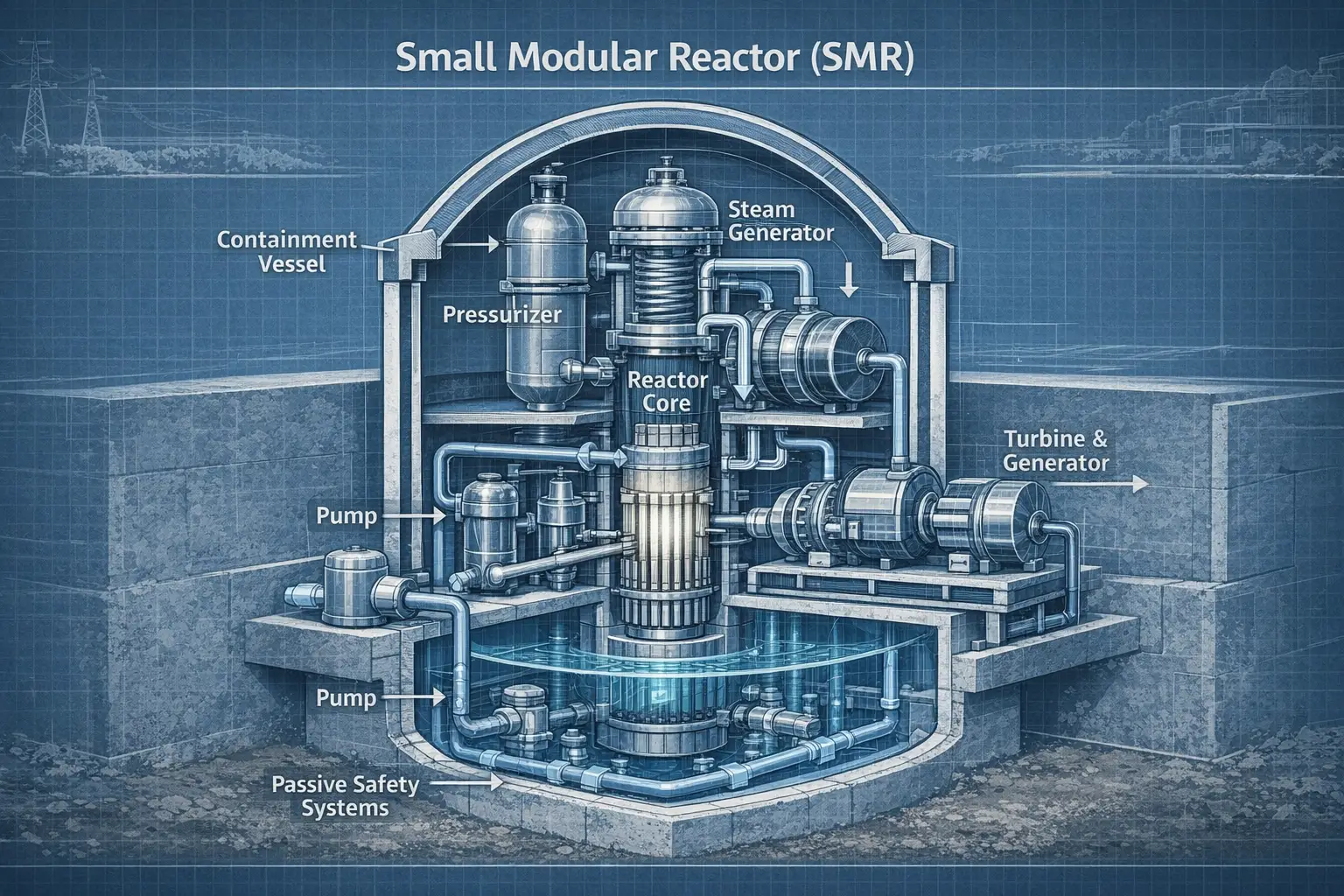
The majority of SMR designs currently closest to deployment are scaled-down versions of the same technology that powers most of the world's existing nuclear fleet: the pressurized water reactor (PWR). These designs use ordinary water both as a coolant (to carry heat away from the nuclear fuel) and as a moderator (to slow neutrons down so they can sustain the chain reaction). NuScale's VOYGR, GE Hitachi's BWRX-300, Holtec's SMR-160, and Rolls-Royce's SMR are all in this category.
The advantage of light-water SMRs is that the technology is well understood. Decades of operating experience exist, the regulatory framework is established, and the supply chains are mature. The trade-off is that water-cooled reactors operate at relatively modest temperatures (around 300°C), which limits their efficiency and restricts them primarily to electricity generation.
Many of these designs incorporate enhanced passive safety features. NuScale's modules, for example, use natural convection, the simple physical principle that hot water rises and cool water sinks, to circulate coolant without needing pumps. If something goes wrong, the reactor can shut itself down and cool itself passively, without any human intervention or external power. This eliminates several of the failure modes that led to accidents like Fukushima.
High-Temperature Gas-Cooled Reactors (HTGRs)
These reactors use helium gas instead of water as their coolant and graphite as the moderator. They operate at much higher temperatures, above 750°C and sometimes exceeding 950°C, which makes them significantly more efficient at converting heat into electricity. The higher temperatures also open the door to industrial applications that water-cooled reactors simply cannot serve, like hydrogen production, chemical processing, and providing industrial-grade heat.
China's HTR-PM is the most prominent example. It uses a "pebble bed" design, where the uranium fuel is encased in thousands of billiard-ball-sized graphite spheres, each containing tiny particles of fuel coated in layers of ceramic and carbon (called TRISO fuel). This fuel form is remarkably robust; the coatings can withstand temperatures well above anything the reactor would experience, even in an accident. The reactor literally cannot melt down in the traditional sense because the fuel is designed to handle extreme heat. X-energy's Xe-100 and Ultra Safe Nuclear Corporation's Micro Modular Reactor (MMR) also fall into this category.
Liquid Metal-Cooled Fast Reactors
These designs use liquid metals, typically sodium, lead, or a lead-bismuth mixture, as coolant instead of water. The metal coolant does not slow neutrons down the way water does, which means the reactor operates with "fast" (high-energy) neutrons. Fast reactors have a remarkable property: they can extract far more energy from nuclear fuel than conventional thermal reactors, and they can even be designed to "breed" new fuel by converting non-fissile uranium-238 into fissile plutonium-239. This means fast reactors could, in principle, extend the world's nuclear fuel supply from centuries to millennia.
Liquid metals also allow reactors to operate at higher temperatures and much lower pressures than water-cooled designs, which simplifies the engineering in some ways. Russia has the most operational experience here, with its BN-600 and BN-800 sodium-cooled fast reactors at the Beloyarsk plant, and is building the BREST-300, a lead-cooled fast reactor. In the SMR space, companies like ARC Clean Technology (developing the ARC-100, a sodium-cooled fast reactor) and others are pursuing these designs.
The challenge with liquid metals is that some of them, particularly sodium, are chemically reactive; sodium burns on contact with air and reacts violently with water. Lead is extremely heavy and corrosive. These properties create engineering challenges that add complexity to the design and maintenance of the reactor.
Molten Salt Reactors (MSRs)
These are perhaps the most conceptually radical of the SMR designs. In a molten salt reactor, the nuclear fuel can be dissolved directly into a molten salt mixture, which then serves as both the fuel and the coolant simultaneously. The salt is pumped through the reactor core, where the nuclear chain reaction heats it up, and then through heat exchangers, where the heat is extracted to generate electricity or for industrial use.
MSRs operate at very high temperatures (around 700°C or more) but at low pressure, essentially atmospheric. This is a huge safety advantage. In a water-cooled reactor, the water is kept under enormous pressure to prevent it from boiling, and a loss-of-pressure event can be catastrophic. In an MSR, there is no such risk. Many designs also include a "freeze plug" at the bottom of the reactor, a section of salt that is kept frozen by active cooling. If the reactor overheats or loses power, the plug melts, and the fuel salt drains by gravity into passively cooled tanks designed to keep the fuel in a safe, subcritical configuration. It is an elegantly simple safety mechanism.
The history of MSRs goes back to Oak Ridge in the 1960s, and the concept was proven to work. Interest is surging today, with companies like Terrestrial Energy (developing the IMSR in Canada), Moltex Energy, Kairos Power (developing a fluoride-salt-cooled reactor with solid fuel), and others pursuing various MSR variants. However, significant engineering challenges remain, particularly around the corrosiveness of hot salts on reactor materials and the need to manage the changing chemistry of the salt as nuclear reactions alter its composition over time.
The Case For SMRs: Why People Are Excited
The buzz around SMRs is not just hype; there are real, structural reasons why governments, investors, and energy companies are pouring money into these technologies. In 2025, nuclear investment hit record levels, with multiple SMR developers raising hundreds of millions in private capital. The European Commission unveiled a strategy in March 2026 to deploy the first European SMR projects by the early 2030s, with projections that SMR capacity in the EU could reach 17 to 53 gigawatts by 2050. The U.S. Department of Energy has committed $900 million in funding specifically to accelerate light-water SMR deployment. Here is why:
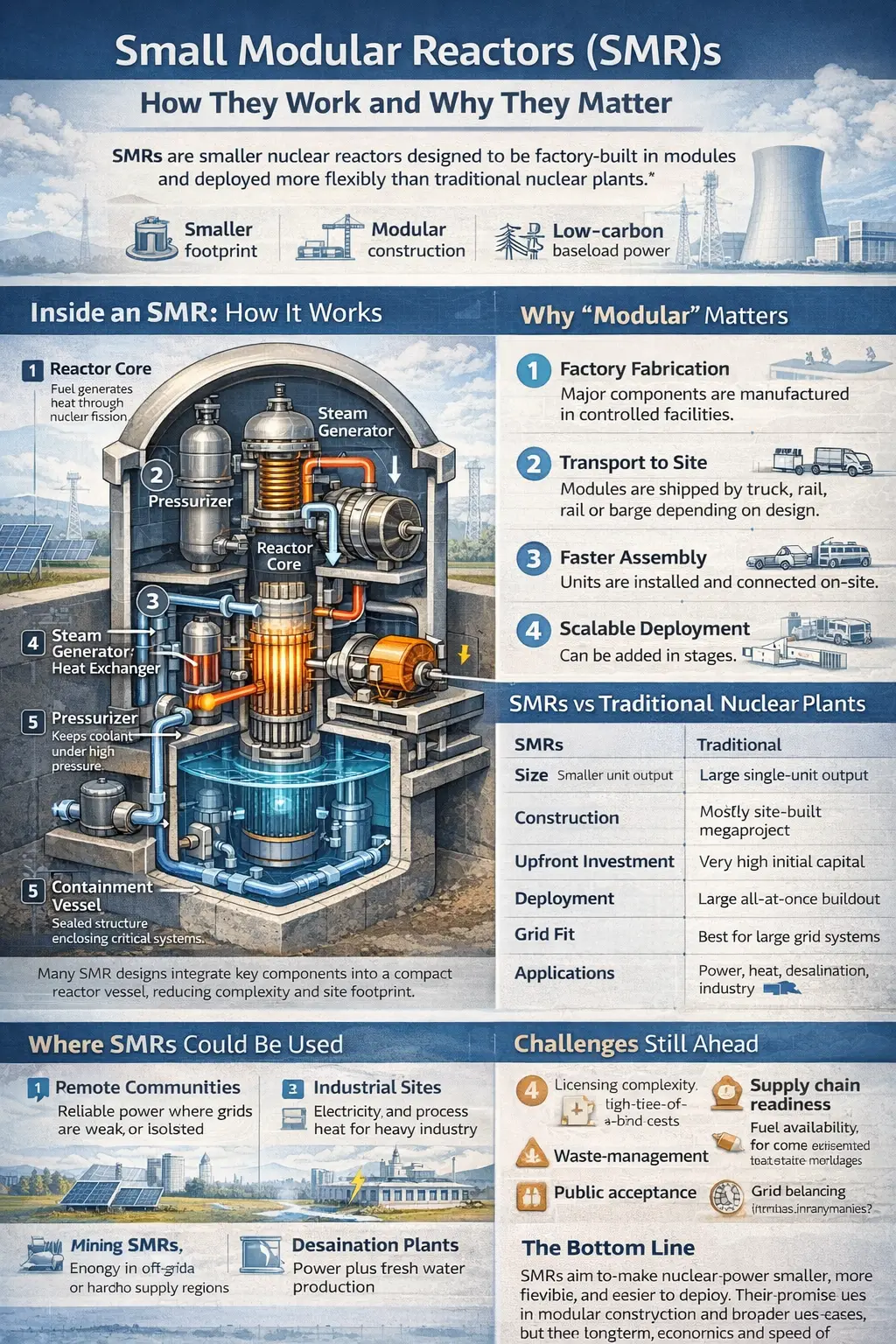 Factory manufacturing and lower upfront cost. The single biggest advantage of SMRs is the potential to shift nuclear construction from bespoke on-site megaprojects to standardized factory production. A factory-built reactor module can benefit from controlled manufacturing conditions, repeatable quality, a trained permanent workforce, and assembly-line efficiencies. The upfront capital cost for a single SMR unit is dramatically lower than for a large reactor, tens or hundreds of millions of dollars versus tens of billions. This makes nuclear energy accessible to utilities, countries, and industries that could never afford a traditional nuclear plant.
Faster construction. Because much of the reactor is built in a factory and shipped to the site, construction timelines could be much shorter, potentially three to four years instead of the ten to fifteen years (or more) that large reactor projects frequently take. Shorter timelines mean less financial risk from interest accumulation and cost overruns.
Flexibility and scalability. Need 300 MW? Deploy a few modules. Need 900 MW? Deploy more. SMRs allow utilities to add capacity incrementally, matching supply to demand without overbuilding. This modularity also makes them suitable for much smaller grids, island nations, remote communities, mining operations, and military bases, where a 1,000 MW reactor would be absurdly oversized.
Enhanced safety. Many SMR designs rely on passive safety systems that use natural physical phenomena, gravity, convection, and thermal expansion, rather than active pumps and human operators, to keep the reactor safe. Smaller cores also contain less nuclear material and less stored energy, reducing the potential consequences of any accident. Some designs are physically incapable of melting down.
Decarbonization beyond electricity. Unlike wind and solar, nuclear reactors produce heat, and lots of it. High-temperature SMR designs (HTGRs and MSRs) can supply the kind of intense, reliable heat needed for industrial processes like steelmaking, cement production, hydrogen generation, chemical manufacturing, and desalination. These sectors are responsible for enormous shares of global carbon emissions and are very difficult to decarbonize with renewables alone.
Powering AI and data centers. The explosive growth of artificial intelligence and cloud computing is creating enormous new demand for reliable, around-the-clock electricity. SMRs are increasingly seen as an ideal power source for data centers — compact, carbon-free, and capable of providing the constant baseload power that these facilities demand. Several major technology companies have been in discussions with SMR developers about exactly this use case.
The Case Against: Challenges and Criticisms
Despite the enthusiasm, SMRs face very real hurdles, and skeptics raise legitimate concerns.
Cost uncertainty. The promise of cheap factory-built reactors remains just that, a promise. No SMR has yet been mass-produced in a factory setting, so the projected cost savings from serial production are theoretical. The one high-profile attempt to build an SMR project in the United States, NuScale's Carbon Free Power Project with the Utah Associated Municipal Power Systems, was cancelled in late 2023 after estimated costs ballooned from $3.6 billion to $9.3 billion. Critics argue that SMRs may end up costing more per megawatt than large reactors due to the loss of economies of scale and that the promised economies of serial production may never materialize if order books remain small.
Unproven at commercial scale. There are over 80 SMR designs in development globally, but as of early 2026, only two — Russia's KLT-40S and China's HTR-PM — are actually operating commercially, and both have faced criticism for low capacity factors since entering service. Almost every other design is still in the licensing, prototype, or conceptual stage. The gap between a promising design on paper and a reliable, cost-competitive reactor generating electricity on the grid is enormous.
Regulatory challenges. Nuclear regulation was built around large light-water reactors. Novel SMR designs, especially those using non-water coolants, advanced fuels, or unconventional configurations, often do not fit neatly into existing regulatory frameworks. Licensing a new reactor design is an expensive, multi-year process. Different countries have different regulatory bodies and requirements, and there is no internationally standardized licensing process for SMRs yet, though organizations like the IAEA are working on harmonization.
Nuclear waste. SMRs still produce radioactive waste. Some designs, particularly those using higher-enrichment fuel (HALEU), may actually produce more waste per unit of electricity than conventional reactors, though the specifics vary greatly by design. The broader challenge of long-term nuclear waste storage and disposal remains unsolved in most countries, and adding new reactor types with different fuel forms and waste characteristics could complicate matters further.
Fuel supply concerns. Many advanced SMR designs require High-Assay Low-Enriched Uranium (HALEU), enriched to between 5% and 20%. Currently, the global supply of HALEU is extremely limited, and most of it has historically come from Russia. Building an independent, reliable HALEU supply chain is a major prerequisite for deploying advanced SMRs at scale, and it is a challenge that governments are only now beginning to seriously address.
Proliferation risks. Spreading nuclear technology more widely, particularly to remote locations, smaller countries, and private companies, raises concerns about nuclear security and the potential for weapons-relevant materials or knowledge to end up in the wrong hands. SMR proponents argue that many designs actually have superior safeguards built in, but the concern is legitimate and must be addressed through robust international oversight.
SMRs vs. Conventional Reactors: How Do They Stack Up?
The comparison between SMRs and traditional large reactors is not a simple case of one being better than the other. They serve different purposes and have different strengths.
Large reactors remain the most efficient way to generate massive amounts of electricity from a single site. A single 1,000+ MWe reactor produces enormous output and, once built and running, generally has very low operating costs per megawatt-hour. The problem is getting them built, the construction risk is immense.
SMRs sacrifice some of that raw per-unit efficiency in exchange for flexibility, speed, and (potentially) lower financial risk. A utility does not need to commit $20 billion and wait 15 years to get power from an SMR. The modular nature means you can build out capacity over time, and the factory approach could, if the industry achieves sufficient scale, drive costs down through learning and repetition. SMRs can also go places large reactors cannot: remote communities, industrial sites, military installations, and developing countries with small grids.
The real test will be whether SMRs can achieve "price and performance parity" with other energy sources. Right now, the first SMRs to be deployed will likely cost as much per kilowatt, or even more, than large reactors. The entire economic thesis depends on costs declining as production scales up. This is plausible; it is exactly what happened with solar panels and wind turbines, but it is not guaranteed for nuclear, which has a history of costs going up, not down, with time.
Where Things Stand in 2026
The SMR landscape in early 2026 is a mix of genuine momentum and sobering reality. On the momentum side, investment is surging. Companies like Radiant, Last Energy, and ARC Clean Technology collectively raised hundreds of millions in private funding in late 2025 alone. The European Union has made SMRs a strategic industrial priority. The U.S. government continues to provide substantial financial support. India has allocated over $2 billion for SMR research and development, aiming for at least five indigenous SMR designs by 2033. More than ten EU member states have expressed interest in deploying SMRs over the next decade.
On the reality side, commercial deployment remains mostly in the future tense. NuScale, the most advanced Western SMR developer, is still years from having an operating reactor, and its stock has faced significant pressure from investors concerned about delays, mounting losses, and the uncertain timeline for its flagship projects. The cancellation of the Idaho project in 2023 remains a cautionary tale about the gap between SMR ambitions and economic reality.
Still, the fundamental drivers of interest in SMRs are not going away. The world needs enormous amounts of new clean energy to meet climate goals. Renewable energy alone has limitations; it is intermittent, it requires vast amounts of land, and it cannot easily provide the high-temperature industrial heat that represents a huge share of global emissions. AI and data center growth are creating new, urgent demand for reliable power. And the geopolitical desire for energy independence is intensifying.
SMRs may or may not fulfill all the hopes invested in them. The technology is real, the physics works, and the engineering challenges, while significant, are not insurmountable. The question is whether the industry can bridge the gap from promising prototypes to affordable, mass-produced, commercially competitive energy systems. The next decade will tell us the answer. If SMR developers can get enough units built to start climbing the learning curve and driving costs down, they could genuinely transform the energy landscape. If they cannot, SMRs risk joining the long list of technologies that were always "just ten years away."
The stakes could hardly be higher. In a world desperate for clean, reliable energy at scale, small modular reactors represent one of the most intriguing, and most uncertain, bets on the table.