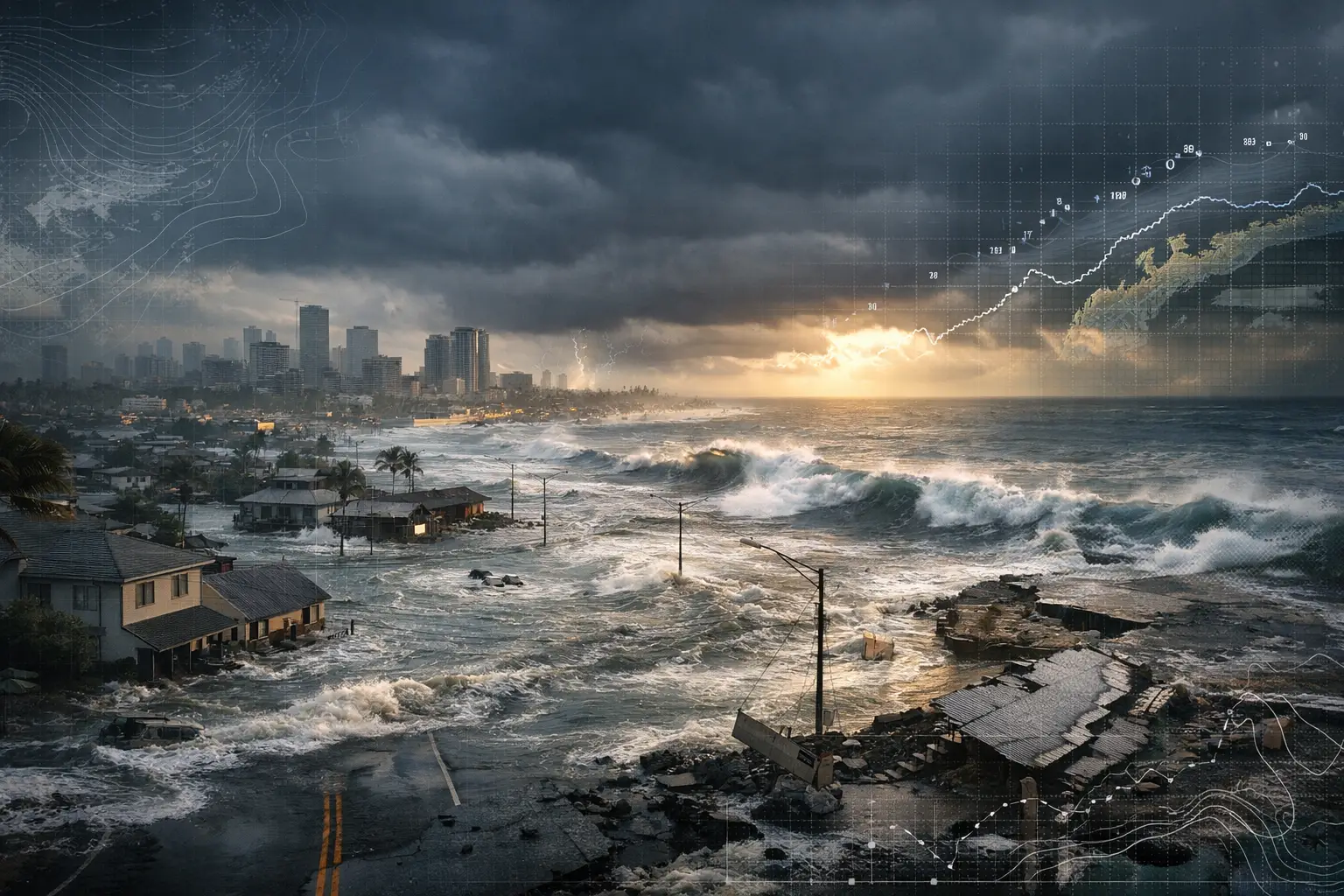
Coastal sea levels around the world are significantly higher than the vast majority of scientific studies have assumed , a startling finding published in the journal Nature that has forced a rethink of one of the most important bodies of research in climate science. The work, led by physical geographer Dr. Philip Minderhoud of Wageningen University & Research (WUR) in the Netherlands and PhD researcher Katharina Seeger of the University of Cologne, reveals a fundamental methodological flaw embedded deep in the scientific literature on coastal hazards, one with potentially life-altering consequences for hundreds of millions of people.
The Scale of the Problem
The study reviewed 385 peer-reviewed scientific publications on coastal exposure, flooding, storm surges, and sea-level rise published between 2009 and 2025, representing the most comprehensive audit of its kind. The findings were striking: more than 99% of those studies contained a significant flaw in how they estimated ocean height relative to land. Of those, approximately 90% relied entirely on theoretical sea-level baselines drawn from so-called "geoid models," rather than using actual, measured coastal sea levels. An additional 9% of studies attempted to incorporate direct measurements but did so incorrectly or without a fully reproducible methodology.
Less than 1% of the studies reviewed were found to have correctly aligned and integrated the data needed to produce accurate coastal risk assessments.
The consequences are substantial. On average, the studies underestimated coastal sea-level height by 24 to 27 centimeters (roughly 10 inches) globally, depending on the specific geoid model used. In many parts of the Global South, particularly Southeast Asia and the Indo-Pacific region, the discrepancy between assumed and actual sea levels exceeded one meter. In extreme individual cases, the difference between the assumed and measured coastal sea level reached between 5.5 and 7.6 meters, reflecting how severely misaligned some local assessments have been.
Crucially, 45 of the flawed studies were cited directly by the United Nations' Intergovernmental Panel on Climate Change (IPCC) in its Sixth Assessment Report, indicating that the blind spot may have influenced major international climate policy planning.
Why the Error Happened: The Geoid Problem
To understand the error, it helps to understand what a geoid model actually is, and what it is not.
A geoid is a mathematical representation of the shape of the Earth based on its gravity field and rotation. It describes what the surface of a hypothetical, perfectly calm, worldwide ocean would look like, the theoretical "resting level" of seawater if it were entirely undisturbed. Geoid models are sophisticated tools and are genuinely useful in many areas of earth science. However, they have a critical limitation: they describe a static ocean, not a real one.
Real coastal sea levels are shaped by a complex and constantly shifting combination of forces: tides, ocean currents, prevailing winds, and water temperature, none of which are captured in geoid models. In regions where these dynamic forces are strong, such as the Indo-Pacific, where powerful monsoon-driven currents and tidal ranges are significant, the gap between geoid-predicted sea level and actual measured sea level can be enormous.
There is also a data problem. Geoid models are most accurate in regions where dense networks of land-based gravity measurements exist, such as Western Europe and North America. In large parts of the Global South, such measurements are sparse, making geoid calculations less reliable. The combination of weaker data and stronger ocean dynamics explains why the discrepancies are largest in precisely the regions most vulnerable to sea-level rise.
A further technical complication arises from the fact that land elevation and sea level are measured using different satellites, each producing data referenced to a different vertical coordinate system. To correctly compare sea level with land height, which is the essential calculation underpinning any coastal risk assessment, those datasets must first be converted into a common reference framework. Most studies in the literature skipped or improperly handled this step.
"If you want to know the elevation of your land relative to sea level, you first have to convert the different data sets into a common reference system," explained Dr. Minderhoud. "Only then can you correctly calculate the relative height difference between them."
The problem is not new to everyone. Minderhoud first became suspicious of geoid model accuracy while conducting fieldwork in Vietnam's Mekong Delta in 2015, where he found the delta to be surprisingly lower than geoid models indicated. He published a warning about the issue in Nature Communications in 2019, noting that errors could be "potentially larger than a century of sea-level rise." Seeger independently encountered similar discrepancies while conducting her PhD research in the Ayeyarwady Delta in Myanmar. Together, they spent more than two years systematically reviewing the global literature to quantify just how widespread the problem had become.
"Most researchers seem to be unaware that it is necessary to use and correctly align measurements of both land and sea when performing coastal impact assessments," said Minderhoud.
The Real-World Impact: Tens of Millions More at Risk
The implications of correcting the baseline are profound.
Using a global dataset derived from satellite measurements of the actual ocean surface, the researchers recalculated what a hypothetical 1-meter rise in relative sea level would mean under corrected assumptions. Compared with the geoid-based estimates that dominate the existing literature, the corrected figures suggest:
31–37% more land area would fall below sea level globally
48–68% more people would be affected, an increase of between 77 million and 132 million individuals
The average global coastal sea level in coastal zones is approximately 20 to 30 centimeters higher than the majority of studies have assumed. That means a very large number of people who are currently considered to live at a "safe" elevation above sea level are, in fact, already living much closer to, or potentially at or below, actual sea level. As oceans continue to rise, those populations will face inundation far sooner than current planning models suggest.
The threat is not uniformly distributed. In Northern Europe and along the U.S. East Coast, where high-quality local data, including detailed elevation models and independent tide gauge networks, is routinely used, the discrepancies are relatively minor. The United States' National Oceanic and Atmospheric Administration (NOAA) estimates that nearly 30% of the U.S. population lives in coastal counties. Those communities face real risks, but the modeling underlying their risk assessments tends to be more robust.
The story is very different in the Global South. Low-lying delta regions, small island states, and densely populated coastal plains across Southeast Asia, South Asia, and the Indo-Pacific are home to hundreds of millions of people, and it is precisely in these regions that the methodological errors are largest and the data quality has historically been poorest. Countries such as Bangladesh, Vietnam, Indonesia, Myanmar, and the Philippines face a situation where the actual degree of exposure may be dramatically greater than official assessments have acknowledged.
Anders Levermann, a climate scientist at the Potsdam Institute for Climate Impact Research in Germany, summarized the concern starkly: "You have a lot of people here for whom the risk of extreme flooding is much higher than people thought."
A Compounding Crisis: Storm Surges, Flooding, and Climate Feedback
Sea-level rise does not threaten coastlines in isolation. Its effects interact with and amplify other hazards in ways that significantly increase overall risk.
Storm surges, which are caused by the winds and low pressure of tropical cyclones and hurricanes, are one of the most dangerous effects of coastal flooding. As baseline sea levels rise, the starting point for these surges moves upward as well, meaning that a storm of the same intensity will push water much further inland and to much greater heights than it would have a decade ago. With global temperatures rising, tropical storms are projected to intensify, carry more rainfall, and potentially shift their tracks into regions less historically accustomed to them.
Coastal flooding also degrades freshwater supplies through saltwater intrusion into groundwater and river systems, undermines agricultural land through soil salinization, and accelerates the erosion of protective features like mangrove forests, wetlands, and coral reefs, natural barriers that, once lost, are extremely difficult to restore. The removal of these buffers further amplifies the impact of future storm events, creating a feedback loop of increasing vulnerability.
For coastal infrastructure, roads, bridges, ports, sewage systems, and power grids, the combination of chronic inundation and episodic storm damage creates mounting repair and replacement costs that many developing nations are poorly equipped to bear.
What Needs to Change
Minderhoud and Seeger argue that geoid models should be retired from use in coastal impact science. To facilitate that transition, the research team used supercomputers to integrate four of the latest global digital elevation models with the most current available coastal sea-level measurements. The resulting corrected datasets have been made freely available in open access through the paper's supplementary materials, giving researchers and governments around the world immediate access to a more accurate foundation for their work.
Whether these improvements in scientific modeling will flow quickly into policy is an open question. In some cases, the mismatch between research and practice may be smaller than feared. The Vietnamese government's planning for the Mekong Delta, for example, draws on locally sourced data and projections rather than the international studies reviewed in the paper, meaning that Vietnamese coastal policy may already reflect a more realistic picture than the global literature suggests.
But many countries lack that local data infrastructure, and for them, the revisions demanded by this research are urgent.
"Now that we've uncovered this blind spot," said Minderhoud, "we hope our methodology will become the new standard by which the global research community can create more accurate coastal assessments. This will help to determine which areas in the world are most affected by future sea-level rise and where coastal adaptation strategies are most urgently needed."
The corrected science also carries implications for climate finance and international development policy. If the populations at greatest risk are larger than currently acknowledged, the scale of investment required in coastal protection, managed retreat, and climate adaptation across the Global South is correspondingly greater.
For communities already living with the daily reality of rising waters, the revision of numbers in academic journals is not an abstract matter. Seventeen-year-old climate activist Vepaiamele Trief, from the South Pacific archipelago of Vanuatu, put it plainly: "These studies, they aren't just words on a paper. They aren't just numbers. They're people's actual livelihoods. Put yourself in the shoes of our coastal communities; their lives will be completely overturned because of sea-level rise and climate change."
In Vanuatu and across the Pacific, the shoreline has already visibly retreated within living memory. On the island of Ambae, a coastal road from the airport to one village has already been rerouted inland as the sea encroaches. For millions of people in low-lying regions across the world, the revision of scientific baselines is not the end of the story; it may only be the beginning of a much harder reckoning.