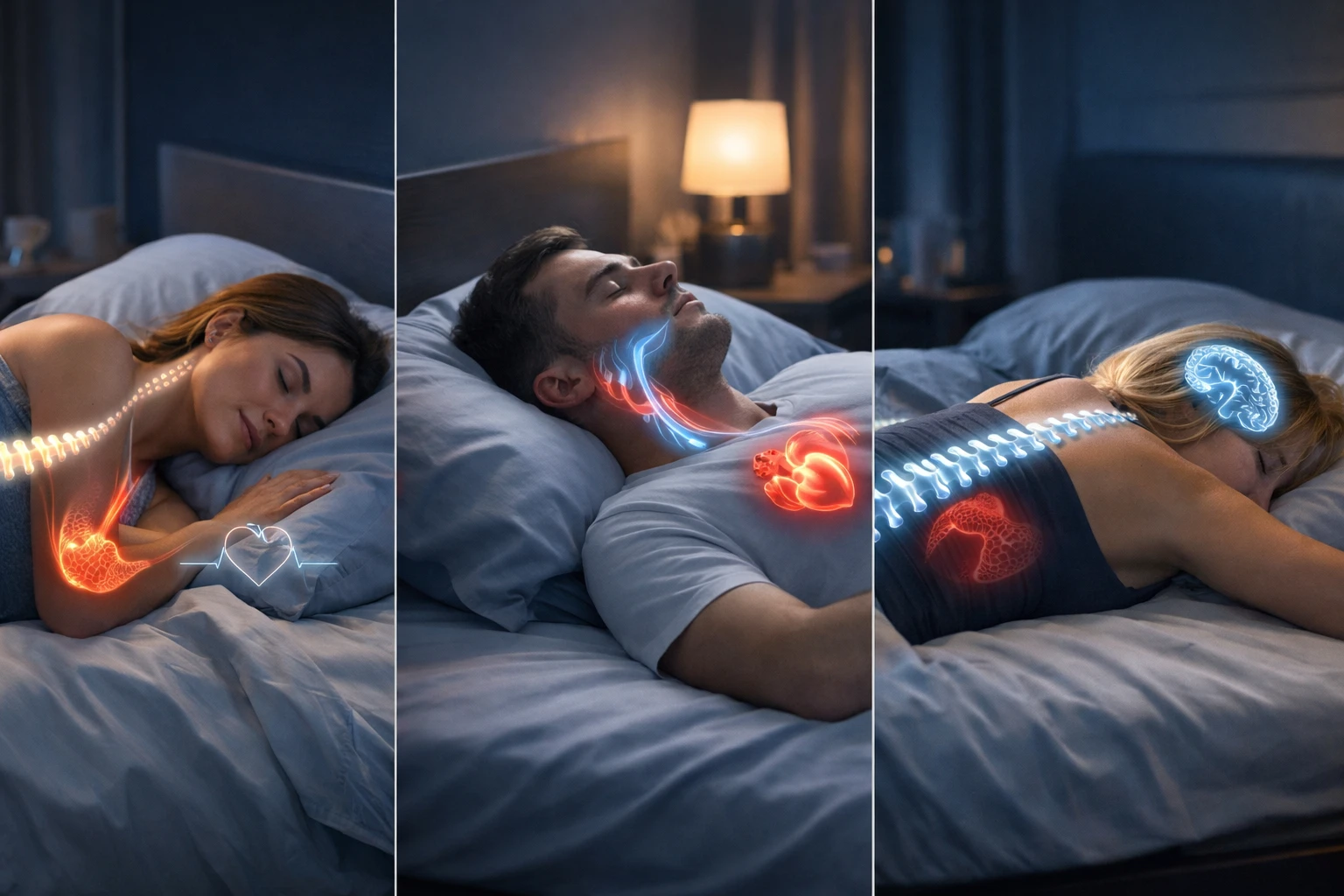
Most people don't give much thought to how they lie in bed. You're tired, you fall into whatever posture your body has learned over decades, and that's that. The position feels natural precisely because it's habitual. But habits aren't always benign, and a growing body of research suggests that the mechanics of sleep posture have consequences that extend well beyond a stiff neck in the morning.
This isn't a fringe concern. According to Dr. Susan Redline, professor of sleep medicine at Harvard's Brigham and Women's Hospital, sleep "touches every body system, including the heart and the brain," partly through its influence on blood vessels and the immune system. Philip Pirtle, a pulmonologist and sleep medicine specialist at Houston Methodist, puts it plainly: sleeping position can affect "sleep disordered breathing, gastroesophageal reflux, musculoskeletal pain, neurological health, and even cosmetic wrinkles of facial skin". That's a wide range of consequences from something most of us consider entirely passive.
Sleep specialist Kat Lederle has pointed out something that doesn't get enough attention: what we do during the day shapes the pain and discomfort we experience at night. A sedentary lifestyle, she notes, is one of the most significant factors. That's worth sitting with. The hours you spend hunched over a desk, or not moving at all, don't disappear when you lie down. They follow you into bed in the form of muscle tension, spinal compression, and postural imbalances that your sleeping position will either relieve or reinforce.
The Side Sleeper's Dilemma
Side sleeping is by far the most common position. More than 60 percent of adults prefer it, and women are twice as likely as men to sleep in the curled-up fetal variant. There are good reasons for its popularity.
For spinal health, side sleeping generally wins. Research from Curtin University in Australia found that people with cervical pain and stiffness in the morning tended to spend more of the night in what researchers call "provocative" postures, which are positions that load the spine asymmetrically. Side sleeping, done well with proper support, tends to keep the spine in a more neutral position than the alternatives.
But not all side sleeping is equivalent. Which side matters.
Left-side sleeping is recommended for pregnant women, where it promotes better blood flow to the fetus by keeping pressure off the inferior vena cava, the large vein that returns blood to the heart. It's also the preferred position for anyone with acid reflux or GERD, because the anatomy of the stomach and esophagus means that lying on the left keeps stomach contents below the lower esophageal sphincter. People with heart failure often report the opposite preference: shortness of breath tends to worsen when they lie on their left side, so they migrate to the right.
The right side also has a notable brain health argument going for it. Research suggests that glymphatic transport, the brain's waste clearance system, operates most efficiently during right lateral sleep compared to both supine (face up) and prone (face down) positions. This matters more than it might initially seem.
The glymphatic system was only formally identified in 2012 by neuroscientist Maiken Nedergaard at the University of Rochester. It is essentially the brain's equivalent of the lymphatic system: a network of channels lined by glial cells through which cerebrospinal fluid circulates, flushing out metabolic waste products. During sleep, the space between neurons expands by roughly 60 percent, allowing this fluid to flow more freely. Among the waste products it clears are amyloid-beta and tau proteins, both of which accumulate as plaques and tangles in Alzheimer's disease. A 2026 randomized trial published in Nature Communications found that glymphatic clearance during normal sleep increased morning plasma levels of these Alzheimer's biomarkers compared to sleep deprivation, confirming that the system actively moves these proteins out of brain tissue during sleep.
The relationship between sleep position and glymphatic efficiency is still being studied, and the science is genuinely contested. A 2025 debate at the SLEEP Annual Meeting featured competing arguments about whether clearance is more active during sleep or wakefulness. The honest summary is that side sleeping, particularly on the right, appears to favor cerebrospinal fluid movement, but exactly how much this translates into real-world Alzheimer's risk reduction remains unknown. Anyone who tells you it's settled is overstating the evidence.
Side sleeping does carry drawbacks. The shoulder bearing most of the load takes significant pressure, which can contribute to joint pain in people who already have rotator cuff problems. Lying on one side for hours compresses facial tissue against a pillow, and over years this can contribute to sleep lines and wrinkles, particularly around the cheeks and chin.
The Back Sleeping Paradox
Back sleeping, known medically as the supine position, is often cited as ideal for spinal alignment. Dr. John Winkelman, a sleep medicine specialist at Massachusetts General Hospital, explains the logic simply: it "avoids any sideways force on the spine." Placing a small pillow under the lower back or beneath the knees enhances this, preserving the lumbar curve without loading the intervertebral discs asymmetrically. People with lower back pain often find that supine sleeping reduces their morning discomfort.
The problem is gravity.
When you lie on your back, the soft tissue at the back of the throat, including the tongue, the soft palate, and the uvula, is pulled downward by gravity. In people with any predisposition toward airway narrowing, this can cause or dramatically worsen obstructive sleep apnea. The data here are unambiguous: supine sleep posture is consistently associated with more severe sleep apnea across all levels of disease severity. A large polysomnographic study found that 60 percent of sleep apnea patients experienced more than a doubling of their apnea-hypopnea index, the standard measure of apnea severity, when sleeping on their back versus on their side. A separate population study found that 75 percent of people diagnosed with obstructive sleep apnea had positional sleep apnea, meaning the back position was driving or worsening their condition.
Sleep apnea isn't a minor inconvenience. The repeated oxygen desaturation events it causes are associated with hypertension, atrial fibrillation, stroke, type 2 diabetes, and chronic fatigue. The body's response to each airway collapse is a brief stress response: the heart rate spikes, cortisol rises, and the sympathetic nervous system activates as if facing a threat. Do that hundreds of times per night for years, and the cardiovascular toll is substantial. A 2024 American Heart Association statement on sleep and brain health drew explicit links between sleep-disordered breathing and long-term neurological and cardiac outcomes.
There's also the issue of diagnosis. Back sleeping during a sleep study inflates measured apnea severity because people naturally spend more time supine when in an unfamiliar lab bed. The same study that found 60 percent worsening in the supine position also noted that misclassification due to body position was responsible for underestimating OSA severity in 20 to 40 percent of cases. That's a significant proportion of people who may be undertreated.
I've had my own sleep study done, and one of the first things the technician noted in my results was the percentage of the night I spent on my back. It's easy to underestimate: most people drift supine during deep sleep without realizing it. Many CPAP-resistant patients turn out to have positional apnea that could be managed with positional therapy alone.
Stomach Sleeping
Stomach sleeping, or prone positioning, is the least common major sleep posture and, from a biomechanical perspective, the hardest one to justify. Only around seven percent of adults sleep this way.
The immediate problem is the neck. To breathe, you have to turn your head to one side. Hold that position for six or seven hours and you're imposing a sustained rotational load on the cervical spine. Research into neck pain risk factors identifies "awkward, sustained posture" as one of the most significant physical contributors to new-onset cervical pain, and prone sleeping is a textbook example. The thoracic spine also loses its natural curve in this position, which flattens the lumbar lordosis and creates muscular tension that can persist into the day.
Stomach sleeping does reduce snoring, because the airway stays relatively open when the tongue falls forward rather than back. But that's a narrow benefit against a long list of costs. Face-down positioning also compresses the cheeks, chin, and orbital area against the pillow, making it one of the main contributors to sleep wrinkles.
For stomach sleepers who can't shift position, the practical advice is consistent: use a very thin pillow, or no pillow at all, to reduce the neck angle, and place a firm pillow under the pelvis to keep the lumbar spine from hyperextending. These measures reduce the damage but don't eliminate it.
Changing Habits That Are Decades Old
Sleep position is deeply ingrained. Research from Queensland University of Technology that used wearable sensors to track nocturnal movement found that position preference was highly stable across nights, even when people switched to an unfamiliar mattress. The body doesn't easily adapt to a new surface, and it certainly doesn't abandon a lifetime's posture because someone read an article about it.
That said, gradual change is possible. Sleep medicine specialists recommend starting in the desired position for a few minutes before settling into sleep, progressively increasing the time spent in the new posture over weeks rather than days. Pillow architecture matters: side sleepers benefit from a firmer, taller pillow that fills the gap between ear and shoulder, keeping the cervical spine level rather than bent. Back sleepers do better with a lower, softer pillow, or a contoured cervical pillow that supports the neck's natural curve without pushing the head too far forward. Placing a pillow between the knees when side sleeping reduces the rotational torque that side sleeping imposes on the pelvis and lower back.
One practical point that often gets overlooked: if you repeatedly wake up in a position you weren't trying to sleep in, your body is telling you something. Persistent inability to stay comfortable in a position is worth discussing with a doctor, especially if it's combined with morning headaches, dry mouth, or daytime fatigue. These can be signs of sleep-disordered breathing that goes beyond simple positioning.
The mattress matters too. A surface that's too soft allows the hips or shoulders to sink excessively, bowing the spine out of alignment regardless of position. Too firm, and it creates pressure points that force frequent repositioning, which fragments sleep. The right firmness is individual, but studies consistently show that medium-firm mattresses reduce back pain across sleeping positions more effectively than either extreme.
None of this is as simple as "sleep on your left side and you'll be fine." The right position for you depends on whether you have reflux or apnea, whether your shoulders are healthy, whether you're pregnant, whether you already have cervical or lumbar symptoms, and how your mattress and pillow interact with your body geometry. What's clear is that position is not a trivial variable. The hours you spend unconscious are not neutral. They're either working for you or against you, and you have more control over that than most people realize.