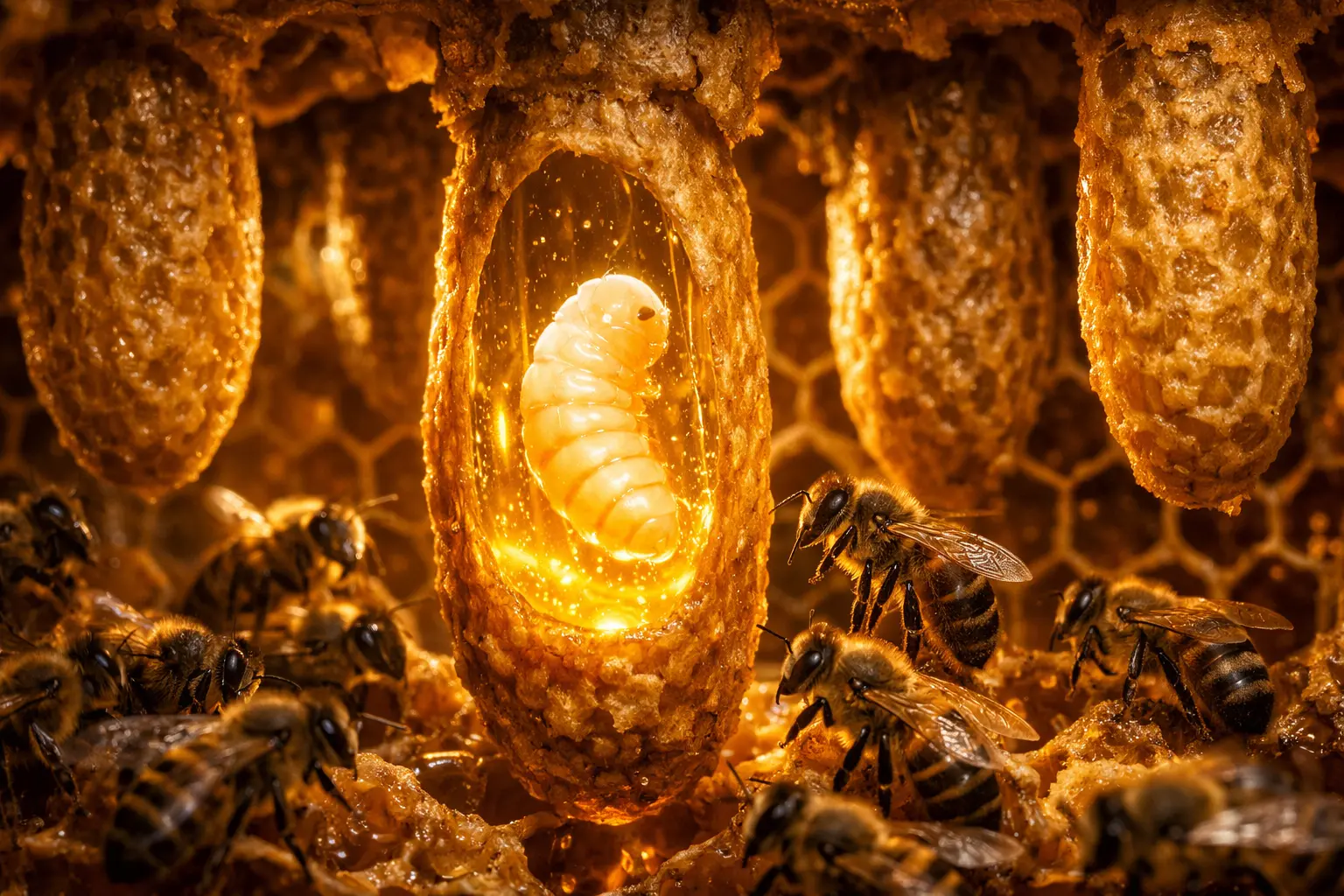
In the world of honeybees, nothing happens by chance. The queen of the hive is neither elected nor chosen at random. Instead, the colony orchestrates a remarkable biological process deep within the honeycomb, where worker bees transform an ordinary larva into the single most important individual in the colony. Signals invisible to the naked eye, specially shaped cells, a unique food source called royal jelly, and a rigorous multi-stage selection process all combine to create the hive's one and only fertile female.
Understanding how queens are made and how colonies manage the high-stakes transition from one queen to the next, opens a window into one of nature's most sophisticated systems of collective decision-making.
When and Why a Hive Replaces Its Queen
Queen replacement is not an everyday event. Bees undertake this disruptive process only when the survival or productivity of the colony demands it. There are three main triggers.
The queen's decline with age. A healthy queen can live five to seven years, but her productivity typically peaks in her first year or two. Over time she lays fewer eggs, and, critically, the amount of queen mandibular pheromone (QMP) she produces begins to decline. QMP is a complex chemical blend that serves as the colony's social glue: it suppresses the reproductive development of worker bees' ovaries, inhibits the construction of new queen cells, and signals to the hive that a healthy, fertile monarch is present. When pheromone levels drop below a threshold the workers can detect, the colony initiates a planned replacement known as supersedure. The old queen may continue to lay eggs even as her successor develops nearby, and in some cases mother and daughter coexist briefly before the older queen is removed.
Swarming and colony reproduction. In the spring and early summer, when the hive's population surges and food is abundant, the colony may reproduce by splitting. The old queen departs with roughly half of the worker force to establish a new nest elsewhere, an event called a primary swarm. Before she leaves, the workers have already begun raising new queen larvae inside the original hive. If conditions remain favorable, additional afterswarms may depart with virgin queens, each taking a portion of the remaining workforce. Swarming is the colony's way of propagating its genes, and the production of multiple queen cells ensures that both the departing and the remaining groups have a viable monarch.
Emergency replacement after sudden queen loss. If the queen dies unexpectedly, is crushed during a hive inspection, or goes missing, the colony senses the abrupt disappearance of her pheromones within hours. Turmoil spreads through the hive, and the workers scramble to initiate emergency queen rearing. Because this process is unplanned, it tends to produce queens that are somewhat smaller and less prolific than those raised under swarming or supersedure conditions, since the larvae selected may already be slightly older than ideal.
Where Do Future Queens Come From?
During one or more mating flights earlier in her life, the queen mated with multiple drones and stored their sperm in a specialized organ called the spermatheca. She can store up to six million sperm cells, enough to last her entire reproductive life. When she lays an egg, she controls whether to fertilize it. Fertilized eggs carry two sets of chromosomes (diploid) and develop into females, either workers or queens. Unfertilized eggs are haploid and develop into drones, the colony's males.
Here is the crucial point: at the moment an egg is laid, there is no genetic difference between a future worker and a future queen. Every fertilized egg has the potential to become either one. The difference is created entirely after hatching, by the way the workers feed and care for the larva. This phenomenon, where genetically identical organisms develop into dramatically different forms depending on environmental signals, is one of nature's most striking examples of epigenetic regulation.
How the Workers Select Candidates
When the need for a new queen arises, the workers do not choose randomly. Research has shown that they preferentially select very young larvae, ideally less than 24 hours old, and generally no more than three days old. Age is critical because a larva's developmental fate is still flexible in these early hours; its organs, and particularly its ovaries, can still be redirected toward full queen development. Larvae older than about three days have already been receiving worker-destined nutrition for too long, and even if switched to a queen diet, they will develop into inferior queens with fewer ovarioles (the tubes in the ovary where eggs form).
Studies have also revealed that the selection process is not a single decision but an ongoing, multi-stage evaluation. Colonies in emergency queen-rearing mode may start constructing anywhere from six to over fifty queen cells in the first 24 hours after losing their queen. However, the majority of these cells are later torn down by the workers before the developing queens ever emerge. In one study, 53% of all queen cells started were destroyed before capping, while only about 43% produced emerged queens. Cells positioned on the central frames of the brood nest, where conditions are warmest and nurse bee density is highest, were significantly more likely to survive this culling process than those on the periphery.
This layered filtering means the colony is not just making queens, it is actively investing in quality control, progressively eliminating candidates of lower reproductive potential and channeling resources toward the most promising individuals.
Building the Queen Cell
Once a larva is selected, the workers immediately begin modifying its environment. They either enlarge the existing cell or construct an entirely new one. A normal worker cell is roughly 5 millimeters in diameter and oriented horizontally. A queen cell, by contrast, is built vertically and has a distinctive elongated, peanut-like shape, extending downward from the face of the comb. It is far larger than a worker cell, giving the developing queen room to grow to her full size, about 20 to 25 millimeters long when mature, significantly larger than any worker.
The orientation of the cell matters. Positioned vertically with the opening pointing downward, the queen cell relies on the viscous properties of royal jelly to hold the developing larva in place. Researchers at the Institute for Biology and Zoology in Germany discovered that two proteins in royal jelly, called MRJP1 and apisimin, form a fibrillar network at the jelly's naturally acidic pH. This network gives royal jelly its thick, gelatinous consistency, effectively suspending the larva in a bath of nutrients and preventing it from falling out of the open-bottomed cell.
Royal Jelly: The Substance That Makes a Queen
Royal jelly is an extraordinarily nutrient-dense secretion produced by the hypopharyngeal and mandibular glands located in the heads of young worker bees, typically nurses between five and fifteen days old. It has a creamy, yellowish-white appearance and a slightly sour taste. Its composition is approximately 60–70% water, with the remainder consisting of a concentrated blend of proteins, sugars, lipids, vitamins, and minerals.
Key components include:
Major Royal Jelly Proteins (MRJPs): A family of proteins (MRJP1 through MRJP9) that provide the primary nutritional basis and play a role in triggering queen-specific gene expression.
Royalactin: A specific protein identified by researchers as a key driver of queen differentiation. Royalactin activates signaling pathways that accelerate larval growth and stimulate ovarian development.
10-Hydroxy-2-decenoic acid (10-HDA): A unique fatty acid found almost nowhere else in nature, believed to have antimicrobial properties and to play a role in caste differentiation.
Simple sugars: Primarily fructose and glucose, providing quick energy.
B-complex vitamins: Including pantothenic acid (B5) in unusually high concentrations.
Amino acids, minerals, and trace elements.
All bee larvae receive royal jelly for the first two to three days after hatching. The difference lies in what happens next. Worker-destined larvae are switched to bee bread, a mixture of pollen, honey, and nectar, while queen-destined larvae continue to receive pure royal jelly in enormous quantities throughout their entire larval development. A queen larva may be surrounded by a pool of jelly far exceeding what she can consume, ensuring she never experiences even a moment of nutritional shortfall.
How Royal Jelly Transforms a Larva into a Queen
The continuous diet of royal jelly triggers a cascade of epigenetic changes, modifications to how genes are expressed, without altering the underlying DNA sequence. Specifically:
Reproductive genes are activated. Genes related to ovarian development are switched on, allowing the queen's ovaries to develop fully. A mature queen possesses roughly 150 to 180 ovarioles per ovary, compared to just 2 to 12 rudimentary ones in a worker bee.
Growth is dramatically accelerated. The queen's developmental timeline from egg to adult is only about 16 days, compared to 21 days for a worker bee. This speed is an evolutionary advantage: the first queen to emerge can eliminate her rivals before they hatch.
Body plan is altered. The queen develops a longer, more tapered abdomen to accommodate her massive ovaries and spermatheca. She lacks the pollen baskets, wax glands, and well-developed brood-food glands that characterize workers. She also has a smooth, reusable stinger (workers have barbed stingers that are typically fatal to use).
Lifespan is extended. While a worker bee lives approximately 6 weeks during the active season (or a few months over winter), a queen can live 5 to 7 years. The mechanism behind this extraordinary lifespan difference between genetically identical organisms remains an active area of research and is believed to be linked to the ongoing nutritional and metabolic effects of royal jelly.
The result is striking: a creature that is genetically identical to any worker in the hive becomes, through nutrition alone, a fundamentally different animal, larger, longer-lived, and capable of laying over 2,000 eggs per day at her peak, more than her own body weight in eggs daily.
The Battle of the Queens: Piping, Tooting, and Mortal Combat
The workers typically raise more than one queen cell as an insurance policy. But the hive cannot sustain two queens indefinitely, and what follows is one of the most dramatic events in the insect world.
The first queen to emerge from her cell faces an immediate imperative: eliminate the competition. She seeks out the other queen cells and uses her smooth stinger to kill her rivals through the wax walls before they can hatch. Queen cells found opened on the side, rather than at the tip, are a telltale sign that a free-roaming virgin queen dispatched the occupant.
Before and during this process, the queens communicate using distinctive vocalizations known as piping. These sounds, produced by pressing the thorax against the comb surface and vibrating the wing muscles without spreading the wings, come in two forms:
Tooting: A series of sounds made by a queen that has already emerged and is free in the hive. The tooting consists of a long initial pulse lasting about two seconds, followed by a series of shorter quarter-second bursts, at a frequency of roughly 400–500 Hz that rises as the virgin queen matures over several days. Tooting announces to both workers and rival queens that a free queen is present.
Quacking: A lower-frequency response (around 350 Hz) made by mature queens still trapped inside their cells. Quacking consists of rapid short pulses and signals to the colony that additional queen candidates are still available.
Research from Nottingham Trent University has demonstrated that this piping duet is not merely queens threatening one another; it functions as a colony-level communication system. The tooting tells the workers to keep unhatched queens confined in their cells, preventing multiple queens from emerging simultaneously. The quacking tells the colony that queens remain available for potential afterswarms. When the quacking finally ceases, the colony knows its reserve of virgin queens is exhausted and the remaining bees must stay put.
If the workers' intentions favor further swarming, they may physically restrain the emerged queen from accessing rival cells, keeping multiple queens alive until afterswarms can depart. But once all swarming is complete and two or more virgin queens find themselves free in the same hive, they fight to the death. The duel is swift and brutal—each queen attempts to sting the other, and only one survives.
The Mating Flight: A Once-in-a-Lifetime Journey
Within roughly six to ten days of emerging, the surviving virgin queen must take her mating flights. These flights are not casual; they are the single most dangerous and consequential event of her life.
The queen flies to a drone congregation area (DCA), a specific zone in the open air, typically 15 to 40 meters above the ground and about 100 to 200 meters in diameter, where hundreds or even thousands of drones from surrounding colonies gather each afternoon during mating season. DCAs are one of the more mysterious phenomena in bee biology. They reappear in the same locations year after year, despite the fact that the drones themselves live only a few weeks. Researchers believe the bees choose these locations based on landscape features—open spaces sheltered from wind, often at the intersection of aerial flyways that follow tree lines, hedgerows, and other terrain features. Radar-tracking studies by Queen Mary University of London confirmed that individual drones routinely visit multiple DCAs on a single flight, hopping between these aerial leks in search of a queen.
The genetic architecture of DCAs is impressive. Studies using microsatellite DNA analysis have found that a single congregation area may contain drones from over 200 different colonies, representing a radius of up to seven kilometers. This extraordinary mixing prevents inbreeding and ensures that the queen mates with an extremely diverse set of males.
When a virgin queen enters a DCA, drones detect her by a combination of visual cues (using their oversized compound eyes) and the scent of her pheromones. A swarm of pursuing males forms a characteristic drone comet, a comet-shaped cluster of up to 100 drones chasing the queen through the air. Mating occurs in mid-flight and lasts only one to two seconds per drone. The process is violent: the drone's endophallus is everted under hemolymph pressure, ejaculation is so forceful it is sometimes audible as a small popping sound, and the act ruptures the endophallus, killing the drone. A portion of the endophallus remains lodged in the queen as a mating sign, which the next drone must remove before coupling.
The queen mates with 12 to 20 drones across one or more flights, storing their combined sperm in her spermatheca. This is her lifetime supply; she will never mate again. If bad weather prevents mating flights for too long, the queen becomes a drone layer, capable of producing only unfertilized (male) eggs, which typically spells the death of the colony.
Assuming the Throne
After returning from her mating flights, the new queen's transition to full maturity unfolds in stages:
First days: The young queen strengthens her body and begins ramping up production of queen mandibular pheromones. As pheromone levels rise, the workers recognize and accept her as the legitimate monarch. If the old queen is still present (as in supersedure), the new queen may kill her, or the workers may allow both to coexist briefly before the older queen dies naturally.
Onset of egg-laying: Within a few days of mating, the queen begins inspecting cells and laying eggs. She walks methodically across the brood comb, dipping her abdomen into each empty cell to deposit a single egg. She controls fertilization as she lays: narrower worker cells receive fertilized eggs (producing female workers), while the wider drone cells receive unfertilized eggs (producing males). At peak production during spring and summer, a high-quality queen can lay 1,500 to 2,000 or more eggs per day.
Lifelong care: The queen spends the rest of her life inside the hive, attended by a rotating retinue of 8 to 12 worker bees at all times. These attendants feed her, groom her, and carry away her waste. They also collect and distribute her pheromones throughout the colony by direct contact and trophallaxis (food-sharing mouth-to-mouth), spreading the chemical signal that maintains order, cohesion, and reproductive suppression among the tens of thousands of workers.
A System Built on Collective Intelligence
What makes this entire process so remarkable is that no single bee directs it. There is no central planner, no foreman, no overseer. The decision to raise a new queen, the selection of candidate larvae, the quality-control culling of inferior queen cells, the acoustic communication between rival queens, and the organized management of swarming are all emergent behaviors, complex outcomes arising from thousands of individual bees following relatively simple rules and responding to local chemical and vibrational signals.
The colony, in a very real sense, functions as a superorganism. And the queen, despite her title, is not a ruler. She is a product of the hive's collective will, manufactured by her sisters from an ordinary egg, shaped by extraordinary nutrition, tested by mortal combat, and maintained in power by the pheromonal contract she renews with every breath. Without a crown or ceremony, a simple larva transforms into the queen who ensures the survival of the entire colony.