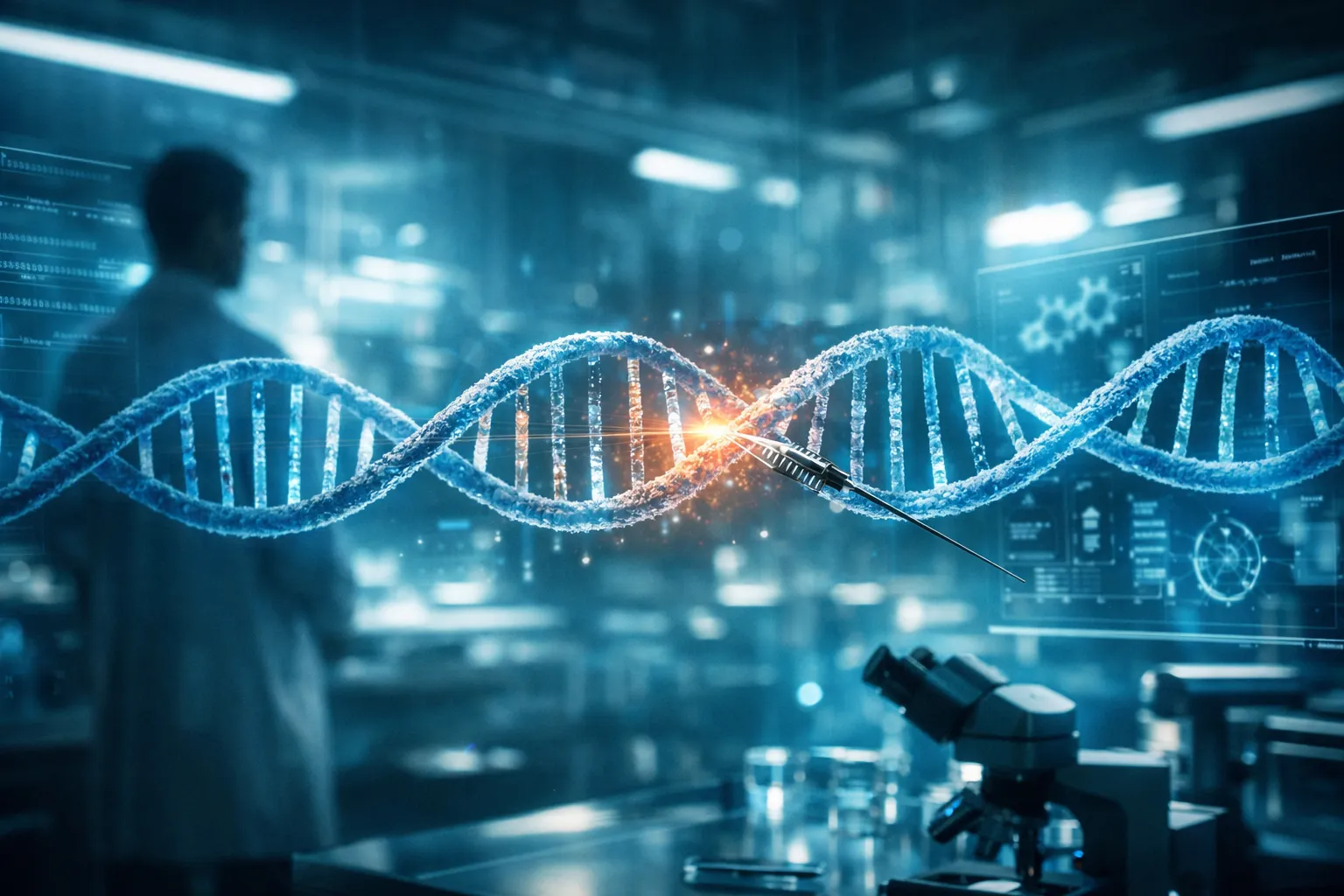
Imagine you could open a book, find a single misspelled word among billions of letters, erase it, and replace it with the correct one. That is essentially what CRISPR does, except the book is your DNA, and the misspelled words are the genetic mutations that cause diseases. In just over a decade, this technology has gone from an obscure observation about bacteria to the most powerful tool ever created for rewriting the code of life.
This is the story of how CRISPR got here, what it can do today, and where it is headed next.
What Is CRISPR, Exactly?
CRISPR stands for Clustered Regularly Interspaced Short Palindromic Repeats. It is a mouthful, which is why everyone just says "CRISPR." At its core, CRISPR is a natural defense system that bacteria have been using for millions of years to fight off viruses. When a virus attacks a bacterium, the bacterium captures a small piece of the virus's DNA and stores it in its own genome, almost like keeping a mugshot on file. If that same virus attacks again, the bacterium recognizes the invader and deploys an enzyme, most commonly one called Cas9, to chop the viral DNA into pieces and destroy it.
Scientists realized they could hijack this system. By designing a short piece of synthetic RNA, called a guide RNA, they could tell the Cas9 enzyme to go to any specific location in any organism's DNA and make a cut there. Once the DNA is cut, the cell's own repair machinery kicks in, and researchers can either disable a gene, fix a mutation, or insert entirely new genetic material.
The simplicity of this is what makes CRISPR so special. Previous gene-editing tools like zinc-finger nucleases (ZFNs) and TALENs also worked, but they were expensive, slow, and required custom-building a new protein for every DNA target. CRISPR just needs a new piece of guide RNA, which is cheap and easy to produce. What used to take months and cost tens of thousands of dollars can now be done in weeks for a fraction of the price.
The Discovery: From Yogurt to Nobel Prizes
The CRISPR story begins in 1987, when a Japanese scientist named Yoshizumi Ishino noticed unusual repeating DNA sequences in the genome of E. coli bacteria. He did not know what they were for. Over the following years, researchers found similar sequences in many other bacteria and archaea, but their function remained a mystery.
The breakthrough came in stages. In 2005, Francisco Mojica, a microbiologist at the University of Alicante in Spain, proposed that these sequences were part of an immune defense system. Then, in 2011, Emmanuelle Charpentier, while studying the dangerous bacterium Streptococcus pyogenes, discovered a previously unknown molecule called tracrRNA that was essential for the CRISPR system to function.
That same year, Charpentier met Jennifer Doudna, an RNA biochemist at the University of California, Berkeley, at a scientific conference. The two joined forces. In a landmark 2012 paper published in Science, they showed that the CRISPR-Cas9 system could be programmed with a synthetic guide RNA to cut any DNA sequence in a test tube. They had turned a bacterial immune system into a programmable pair of molecular scissors.
Six months after that publication, Feng Zhang at the Broad Institute of MIT and Harvard demonstrated that CRISPR worked in mammalian cells, including human cells, opening the door to medical applications.
The field exploded. In 2020, Charpentier and Doudna were awarded the Nobel Prize in Chemistry for their work. It was the first time two women shared the chemistry prize, and it came less than a decade after their foundational paper, one of the shortest gaps between a scientific discovery and a Nobel recognition in the award's history.
How CRISPR Actually Works in the Body
When CRISPR is used as a medical treatment, the general process works like this:
A doctor collects cells from a patient, often blood stem cells. In a laboratory, scientists introduce the CRISPR components (the Cas9 enzyme and the guide RNA) into those cells using various delivery methods, such as electroporation (zapping cells with electricity to open tiny pores) or lipid nanoparticles (tiny fat-based bubbles that carry the editing machinery into cells). The guide RNA directs the Cas9 enzyme to the exact spot in the genome that needs to be changed. Cas9 makes a precise cut in the DNA at that location. The cell then repairs the break, and depending on the strategy, researchers can disable a faulty gene, correct a mutation, or insert a new piece of DNA. Finally, the edited cells are returned to the patient.
There are also "in vivo" approaches, where the CRISPR components are delivered directly into the patient's body, typically injected into the bloodstream inside lipid nanoparticles that are designed to home in on specific organs like the liver.
The First Approved CRISPR Medicine: Casgevy
The moment CRISPR moved from theoretical promise to real-world medicine came on December 8, 2023. The U.S. Food and Drug Administration approved Casgevy (exagamglogene autotemcel), the first-ever therapy based on CRISPR-Cas9 gene editing. Developed by Vertex Pharmaceuticals and CRISPR Therapeutics, Casgevy treats sickle cell disease in patients aged 12 and older.
Sickle cell disease is a hereditary blood disorder that affects roughly 100,000 people in the United States alone, with the majority being Black Americans. The disease causes red blood cells to become rigid and sickle-shaped, blocking blood vessels and triggering episodes of excruciating pain called vaso-occlusive crises. These crises can damage organs and shorten life expectancy. The median age of death for patients with sickle cell disease in the U.S. is approximately 45 years.
Casgevy works by editing a patient's own blood stem cells. Specifically, it targets a gene called BCL11A, which acts as a brake on the production of fetal hemoglobin, a type of hemoglobin that the body normally produces before birth but then shuts off. By disabling BCL11A in blood-forming stem cells, Casgevy allows the body to produce high levels of fetal hemoglobin again. This fetal hemoglobin prevents red blood cells from sickling, effectively eliminating the painful crises.
In clinical trials, the results were striking. Of 31 patients treated, 29 had no severe vaso-occlusive episodes for at least 12 consecutive months during a two-year follow-up period. The FDA also later approved Casgevy for transfusion-dependent beta thalassemia, another inherited blood disorder.
But Casgevy comes with a staggering price tag: $2.2 million for a single course of treatment. That figure does not include the cost of chemotherapy, hospitalization, and months of recovery that the treatment requires. While the lifetime cost of managing severe sickle cell disease can reach $4 to $6 million, the upfront expense raises serious questions about who can actually access this cure.
Beyond Sickle Cell: The Expanding Clinical Pipeline
Casgevy was just the beginning. As of early 2025, roughly 250 clinical trials involving gene-editing therapies were being tracked worldwide, with more than 150 actively enrolling or treating patients. The conditions being targeted span a remarkable range.
Blood disorders continue to lead the field. Multiple Phase 3 trials are underway for both sickle cell disease and beta thalassemia, and researchers are developing next-generation therapies that may be simpler and cheaper to administer than Casgevy.
Hereditary angioedema is another area showing exceptional promise. Intellia Therapeutics developed an in vivo CRISPR treatment, meaning it is delivered directly into the body via a single intravenous infusion, without the need to remove and edit cells in a lab. In clinical trials, eight of 11 participants who received the higher dose were completely free of painful swelling attacks for 16 weeks after treatment, with some remaining attack-free for as long as 13 months. A global Phase 3 trial began in January 2025, with the hope of commercial availability by 2027.
High cholesterol and heart disease are being targeted as well. In November 2025, a Cleveland Clinic-led Phase 1 trial reported that a one-time CRISPR infusion called CTX310 safely reduced both LDL ("bad") cholesterol and triglycerides in 15 patients with difficult-to-treat lipid disorders. The treatment switches off a gene called ANGPTL3 in the liver. People who are born without a working copy of this gene naturally have lower cholesterol and lower rates of heart disease, with no apparent negative consequences. The results were published in the New England Journal of Medicine, and Phase 2 studies are planned for 2026.
Cancer is another major frontier. CRISPR is being used to engineer more effective immune cells for fighting tumors. Researchers are editing T-cells, a type of white blood cell, to create what are known as CAR-T therapies. By using CRISPR to knock out certain genes in donor T-cells, scientists can make "off-the-shelf" cancer-fighting cells that can be given to any patient without being rejected by the immune system. Dozens of trials are underway for various blood cancers, including leukemia, lymphoma, and multiple myeloma.
Autoimmune diseases like lupus are also attracting attention, with several trials now testing CRISPR-edited cell therapies for systemic lupus erythematosus.
The First Personalized CRISPR Therapy
Perhaps the most remarkable milestone of 2025 was the creation of the first fully personalized CRISPR therapy. A team at Children's Hospital of Philadelphia (CHOP) and Penn Medicine designed a custom treatment for an infant named KJ, who was born with a rare metabolic disease called severe carbamoyl phosphate synthetase 1 (CPS1) deficiency. This condition prevents the body from properly processing nitrogen, leading to toxic ammonia buildup that can cause brain damage and death.
Within six months of identifying KJ's specific genetic mutation, the team designed and manufactured a base-editing therapy delivered via lipid nanoparticles to the liver. In late February 2025, KJ received his first dose. He has since received follow-up doses and is reported to be growing well and thriving.
This case is significant not just for its outcome but for what it represents: the possibility of creating on-demand gene-editing therapies tailored to a single patient's unique mutation. There are thousands of rare genetic diseases, many affecting only a handful of people worldwide. Traditional drug development, which costs hundreds of millions of dollars and takes years, simply does not work for such small patient populations. Personalized CRISPR therapy could change that equation entirely.
Next-Generation Editing: Base Editing and Prime Editing
The original CRISPR-Cas9 system works by cutting both strands of the DNA double helix. While effective, this "scissors" approach can sometimes lead to unwanted insertions, deletions, or rearrangements at the cut site. Two newer approaches aim to edit DNA more gently.
Base editing, developed around 2016, does not cut the DNA at all. Instead, it chemically converts one DNA letter into another, for example, changing a C to a T, without breaking the double helix. Think of it as using correction fluid on a single letter rather than cutting out an entire sentence and gluing in a new one. Base editing is being used in several active clinical trials. Beam Therapeutics, for example, is running a trial for alpha-1 antitrypsin deficiency, a genetic liver disease. In their highest-dose group, approximately 90% of the disease-causing protein in patients' blood was replaced by the healthy version within just two weeks.
Prime editing, introduced in 2019, is even more precise. It can make any type of small edit, insertions, deletions, or swaps of any DNA letter without cutting both strands. It is sometimes called the "search and replace" function for DNA. Prime editing is still in earlier stages of development, but clinical trials are expected to begin in 2026 for certain conditions.
Epigenome editing represents yet another frontier. In January 2026, researchers at UNSW Sydney published work showing they could reactivate silenced genes without cutting DNA at all. By removing chemical tags (methyl groups) that act as molecular switches, they turned a fetal blood gene back on, offering a potentially safer way to treat sickle cell disease with fewer side effects than traditional CRISPR cutting.
The Risks and Challenges
For all its promise, CRISPR is not without significant concerns.
Off-target effects remain the biggest technical worry. The guide RNA might occasionally direct Cas9 to cut DNA at the wrong location, potentially disrupting a healthy gene. While newer tools and better guide RNA designs have dramatically reduced this risk, it has not been eliminated entirely. The FDA requires 15 years of follow-up monitoring for all CRISPR-based therapies to watch for long-term problems, including cancer.
The He Jiankui controversy cast a long shadow over the field. In 2018, Chinese scientist He Jiankui shocked the world by announcing that he had used CRISPR to edit human embryos, which were then implanted and resulted in the birth of twin girls. He claimed to have disabled a gene called CCR5 to make the children resistant to HIV. The scientific community condemned the experiment as reckless, unethical, and medically unjustified. The edits were made to germline cells, meaning they could be passed on to future generations, crossing a line that researchers had agreed should not be crossed. He was sentenced to three years in prison by Chinese authorities. The incident led to widespread calls for a moratorium on heritable genome editing, and international bodies continue to debate how to regulate germline modifications.
Cost and access present a towering barrier. At $2.2 million per treatment, Casgevy is one of the most expensive medicines ever approved. While the economics may make sense over a patient's lifetime, the upfront cost is prohibitive for most health systems. In the United States, the federal government has launched a program to negotiate discounts for Medicaid patients, but globally, the picture is far more challenging. Most people with sickle cell disease live in sub-Saharan Africa and India, where even basic treatments like hydroxyurea, available for just $67 per person per year, remain out of reach. Scaling CRISPR therapies to serve these populations will require entirely new approaches to manufacturing, delivery, and pricing.
Delivery challenges also persist. Getting the CRISPR machinery into the right cells in the right organ remains difficult. Lipid nanoparticles work well for targeting the liver, but reaching other organs, the brain, the lungs, and the muscles is much harder. Researchers are actively developing new delivery vehicles, but this remains one of the field's biggest bottlenecks.
Financial pressures on the industry itself are real. Many CRISPR-focused companies have faced layoffs and reduced pipelines as venture capital investment has tightened. Companies are increasingly concentrating on a smaller number of products they can bring to market quickly, rather than pursuing a broad range of diseases.
The Ethical Landscape
Beyond safety and cost, CRISPR raises deep ethical questions that society is still grappling with.
The distinction between "somatic" and "germline" editing is central to these debates. Somatic editing changes DNA in a patient's body cells, the effects stay with that individual and are not inherited. All currently approved CRISPR therapies are somatic. Germline editing, by contrast, changes DNA in embryos or reproductive cells, meaning those changes would be passed to future generations. While germline editing could theoretically eliminate genetic diseases from family lines permanently, it also raises the specter of "designer babies" and unintended consequences that could ripple through generations.
There are also questions about equity. If gene editing can cure diseases but only for those who can afford it, does it widen the gap between the wealthy and the poor? Who decides which conditions are "diseases" worth editing, and which are simply variations in human biology? These questions do not have easy answers, and they will only become more pressing as the technology matures.
Where CRISPR Is Headed
The next few years are shaping up to be pivotal. Several key developments are expected:
The shift from "ex vivo" therapies (where cells are removed, edited, and returned) to "in vivo" therapies (where editing happens directly inside the body) could dramatically simplify treatment. Intellia's hereditary angioedema therapy, which requires just a single infusion, is a glimpse of this future.
Platform therapies, where a single treatment framework can be adapted for different mutations within the same disease, could make personalized medicine far more scalable. In 2026, the first clinical trials are expected to test this approach, treating groups of patients who share the same disease but have different underlying mutations.
The convergence of CRISPR and artificial intelligence is accelerating. AI is being used to design more efficient guide RNAs, engineer better Cas proteins, and optimize delivery systems. This marriage of biology and computation is likely to shape the next decade of progress.
And beyond human medicine, CRISPR is being used to develop disease-resistant crops, control mosquito-borne illnesses, create new diagnostic tools, and even explore the possibility of de-extincting species.
A little over a decade ago, CRISPR was an obscure acronym known mainly to microbiologists studying bacterial immune systems. Today, it is curing diseases that were once considered untreatable, earning Nobel Prizes, and reshaping our understanding of what is medically possible. The first CRISPR medicine was approved in 2023. By 2025, the first personalized CRISPR therapy had been given to a baby. Approximately 250 clinical trials are now exploring treatments for everything from blood disorders to cancer to heart disease.
The challenges are real, off-target effects, staggering costs, delivery limitations, and profound ethical questions. But the trajectory is unmistakable. CRISPR has not just changed the game for genetic medicine. It has changed the game itself.
We are still in the early chapters of this story. But what has already been written is extraordinary.